..social skills: their ability to connect, empathize, and recognize a good original idea and persuade people to back it.
The first two, cognitive and emotional empathy, can be the basis of manipulation if a leader has no ethical scruples about doing so.
(iii) ..concern
Pic Lord Byron born 22nd Jan 1788 in London Britain famous ravisher and up-the-duffer of 12 year old Greek girls
Many thanks Daniel Goleman for these notes on Emotional-intelligence and worldwide broken-down counter-productive Official-permission 2 speak-write-publish post Greenspan & Friedman leadership.
(iii) ..concern
John Blundell
Australia
Lord Byron born on 22 January 1788 in London Britain ravisher and up-the-duffer of 12 year-old Greek girls major alibi and/ or ambition apparently some kind of revolution in 1821 cwoaoaorrrrhhhh Kaz Cook 1980-ish Australia
LADIES & GENTLEMEN there ff the second Antonio Gramsci-inspired radical critique of mine these 3 or 4 hours..
Therefore my exquisite 5 set series formatting, document coherency epistemological validity and Third-decade of 21C thematic clarity are assured but I’ve not reviewed the shit.
We have no time to fool around OR look after numpties, gangsters and sads like my $300 a wk live-in landlady who verbally abuses me each 10 daze or so for managing my tenancy & working days with èclat..
We as ever thank good old Tim Cook of for a keypad with squiggly things above English vowels did i get that right and below consonants continents and shit did i get that right too?
🥸
“A researcher spent two years documenting what AI is doing to the way humans think.
“His conclusion fits in one sentence. AI is standardizing human thought. Across societies. Across cultures. Across generations. Simultaneously. At a scale no technology in history has ever achieved.
“The paper is called “The Impact of Artificial Intelligence on Human Thought.” Published July 2025 on arXiv. Written by independent researcher Rénald Gesnot, categorized under Computers & Society and Human-Computer Interaction.
“It is not a benchmark paper. It is not a capability paper. It is something rarer — a systematic analysis of what happens to human cognition, creativity, and intellectual diversity when billions of people outsource their thinking to the same machine.
“Here is the mechanism the researcher describes. When you ask an AI a question, you get an answer shaped by the model’s training data, its fine-tuning, its alignment process, and the preferences of the company that built it. That answer is not neutral. It reflects a specific set of values, framings, and assumptions. Usually Western. Usually English-dominant. Usually optimized for engagement and approval.
“When 500 million people ask the same AI similar questions and receive similar answers, those answers become reference points. People quote them. Build on them. Argue from them.
“The diversity of starting points — different cultures, different intellectual traditions, different ways of framing problems — begins to compress.
“The researcher describes this as cognitive standardi [s] ation.
“Not censorship. Not propaganda. Something subtler and harder to reverse. A gravitational pull toward the outputs of a small number of models, trained by a small number of companies, reflecting a small number of worldviews.
“The paper also documents algorithmic manipulation — AI systems that exploit cognitive biases to influence behavior.
“The way recommendation algorithms produce filter bubbles.
“The way AI-generated content exploits confirmation bias.
“The way personalization systems learn what you already believe and feed it back to you amplified. “And then the creativity question — the one nobody wants to answer directly.
When AI can produce a poem, an essay, a business plan, or a research summary in seconds — and when that output is often indistinguishable from or preferred over human-generated content — what happens to the human practice of creating those things?
“Not the output. The practice. The struggle. The failure. The slow development of a personal voice through years of imperfect attempts.
“The researcher argues that cognitive offloading — delegating thinking tasks to AI — does not merely save time.
“It atrophies the mental capacity that the offloaded task was building.
“Microsoft and Carnegie Mellon found this empirically in 2025: higher AI trust correlates directly with measurably lower critical thinking.
“The researcher provides the theoretical framework for why. The paper ends with a question the researcher admits he cannot answer.
“Once a generation grows up with AI as the default thinking partner — once the habit of outsourcing cognition is formed before the habit of independent thought is developed — what does intellectual autonomy even mean?
“And is it already too late to find out?”
Source: Gesnot, R. · “The Impact of Artificial Intelligence on Human Thought” · arXiv:2508.16628 · arxiv.org/abs/2508.16628 · July 2025
🌏
MANY thanks 2 our writer ≣ acknowledgement ff tomorrow ELT
🦘
JOHN BLUNDELL 🦘🌏
• Thematics 2-5 set series logic
• Neurocognitive education and health
• Reform of the internet – the involution
• Immediate re-orientation of all studies in 25k universities
• REMOVAL of all Healthy-age circa 12-15 arrested psycho-spiritual development sociopaths in positions of public trust, authority & responsibility, worldwide, immediate
GEA & quadratic Newtonian 🐒🐒🐒🐒s with Olivetti Group @MIT ⌨️⌨️⌨️⌨️⌨️⌨️⌨️⌨️⌨️⌨️⌨️⌨️ thanks EK
Was this the 2015 big du-bl-de-thatcherian investor pitch for VF ?
🥸
“The never-ending AI bullshit machine continues, with Anthropic and Dario Amodei now manufacturing more hype every day than Donald Trump while he’s on the toilet at 2 AM vomiting on social media.
“Let’s get a few things straight. Anthropic is launching a massive propaganda campaign about its products designed to boost the company’s valuation, no different than Sam Altman and OpenAI three years ago, when they were promising that AI would shortly solve all of the world’s major problems (we’re still waiting Sam).
“Mythos cannot actually hack anything by itself in real-world environments, it cannot implement complex end-to-end attacks. It just identifies software vulnerabilities and suggests scripts to exploit them. In most realistic computing environments, it would be instantly crushed by specialized firewalls, EDR, and just about any generic AV software. Claude Code and all the recent releases are great, definitely a step above the competition, but they’re not gamechangers yet. You can’t vibecode your way to complex enterprise software. Setting up an HR system is not like setting up a personal website.
“Anthropic is manufacturing a lot of hype to position itself for the next funding rounds, and none of us should be fooled by what’s actually going on.
“Surveys and reports are consistently showing that most corporations aren’t really seeing a major productivity boost from AI adoption. But what they are about to see are massive cost spikes from Big Tech for all the new shiny AI software platforms they’re using, and those Christmas gifts are likely to come sooner rather than later! And that’s not even getting to the major challenges of AI adoption and integration. Just today I read about a Claude agent going rogue and deleting large parts of a company’s data.
“AI adoption is not a panacea and it will solve absolutely none of the world’s major problems. Instead, it’s going to be messy, complex, tentative, full of false starts, twists and turns, and subsumed under the broader class struggles and geopolitical rivalries of global capitalism.
“Buckle up because it’s going to be a bumpy ride.”
Substack account of the writer
John Blundell
• Thematics 2-5 set series logic
• Neurocognitive education and health
• Reform of the internet – the involution
• Immediate re-orientation of all studies in 25k universities
• REMOVAL of all Healthy-age circa 12-15 arrested psycho-spiritual development sociopaths in positions of public trust, authority & responsibility, worldwide, immediate
🦘🌏
^ᴮ In early 2015, Musk and Altman were having regular Wednesday dinners and discussing apocalyptic scenarios involving AI. By May 2015, they aimed to create a “Manhattan Project” for safe AGI (Artificial General Intelligence)
On Symbiosis: Musk agreed with Altman that humans were already a “human-machine collective symbiote”
This is out right theft and extortion. I think their plan is to tax you until you own nothing and have nothing.
@IMemeθ ☞
You got it!
@Concetta8631
That doesn’t even include capital gains taxes. It’s insane how much of the pie the government takes with no financial skin in the game
@IMemeθ ☞
Exactly. You are bing punished for being successful.
@chatdeluge1 ☞
its all insane, they just keep grabbing more and more, with no justification, they don’t have a right to take your property, you money, your liberty if you refuse or can’t pay. when did we give them all this power over free citizens?
@MixyPisa 👉🏻
We get that here in Australia – it’s called “stamp duty” but it’s a similar percentage.
But annual property taxes are an itemised bill of services like water, drains, and garbage collection, and much smaller than is typical in the US.
🥸🤨😇🤩🥸🤨😇🤩🥸🤨😇🤩
New Jersey realtor says her client has to pay a $185K transfer tax on a home they’re selling for $4 million.
In simple terms, that $185K is the government’s “cut” for updating the public record to show who owns the property.
If her client were moving out of state, they would also pay what’s often called the New Jersey Exit Tax. The state withholds 2% to make sure you don’t leave without paying any taxes due on the sale.
New Jersey’s so-called “mansion tax” has also changed: the original 1% flat tax on homes over $1M has been replaced by a tiered system, paid by the seller, increasing by 0.5% for every additional $500K.
As one observer rightly noted, that money could have remained in the hands of individuals, as a salary, a raise, or startup capital, to fuel real economic growth, create jobs, and build wealth from the bottom up. Instead, it’s seized through taxation and funneled through politicians and bureaucrats, who allocate it to social programs and pet projects with little accountability. History shows these initiatives are riddled with undetected waste, fraud, and inefficiency, often delivering minimal benefits to those they’re supposed to help while expanding government control.
😵💫🥴😷🤮🥴😷😵💫🤮🥴😷😵💫🤮
READERS
It struck me the svelte & shiny young bourgie lady from Uh Merry 🚗🚘🚙🚕🚓 Delete ‘s’ had hit the micro button bigtime with her quite polite and decent questioning of LSF Gvrnmnt – HOUSEHOLDER relations and this dialled out remarkably neatly with my yesterday‘s @WordPress piece all about the big ideas of tenured men operating in both classical & neoclassical Socratic Logic academic formats in the European & East-coast You-essay now AI-gen for up to $5,600 a paper Ivy League Belle Epoch macro ideational milieux OK ..
John
Quite Probably, Rosanne^
JB maļu 🇦🇺🌏
ᵛmy wife-person 13/11/1993 to sometime in 2007 (i never sent the government births, deaths & marriages Divorce form back to Adelaide from Thevenard
• “Mercantilism is a state-driven, nationalistic economic model focused on accumulating wealth (gold/silver) via trade surpluses and regulation, prevalent from the 16th to 18th centuries.”
• “Capitalism is a system based on private ownership, free markets, and profit maximization, driven by voluntary exchange and innovation.”
• “Now what’s cooler than bein’ cool? (ICE COLD!) I can’t hear ya’ I say what’s cooler than bein’ cool? (ICE COLD!) … Now I wanna see y’all on y’all baddest behavior, Lend me some suga’, I am your neighbor”. (..on the album Speakerboxxx/The Love Below 2001)
• Chomsky explains how first the education system and then the mainstream media filter journalists for ‘obedience and subordination.’ (1996)
• Chomsky replies, ‘I am not saying you’re self-censoring. I’m sure you believe everything you’re saying. But what I’m saying is that if you believed something different, you wouldn’t be sitting where you’re sitting’ (1996)
..advctd. 4 the rght of the ppl 2 vrthrw their gvrnmnt / ∴ issued with a writ 4 his arrest early in 1792
That stuff ➸
‘The school of Cobden is affiliated in general outlook both to the doctrine of natural liberty and to the discipline of Bentham. It shared with the Benthamites the thoroughly practical attitude dear to the English mind. It has much less to say of natural rights than the French theorists. On the other hand, it is saturated with the conviction that the unfettered action of the individual is the mainspring of all progress1 .. ..
‘ 1 “If I were to sum up in a sentence the difference and the connection (between the two schools) I would say that the Manchester men were the disciples of Adam Smith and Bentham, while the Philosophical Radicals followed Bentham and Adam Smith” ( FW Hirst, The Manchester School, Introd. p 21)
‘The Corn Laws, as even the tax reformers of our own day admit, were conceived in the interest of the governing classes. They frankly imposed a tax on on the food of the masses for the benefit of the landlords, and as the result of the agricultural and industrial revolutions which had been in progress since 1760, the masses had been brought to the lowest point of economic misery. Give to every man the right to buy in the cheapest and sell in the dearest market, urgedthe Cobdenites, [AND TRADE WOULD AUTOMATICALLY EXPAND.] ..
‘The business career would be open to the talents. The good workman would command the full money’s worth of his work, and his money would buy him food and clothing at the lowest rate in the world’s market. ..
‘Only so would he get the full value of his work, paying toll to none. Taxes there must be to carry on government, but if we looked into the cost of government we found [THAT IT DEPENDED MOSTLY ON ARMAMENTS]. Why did we need armaments? First, because of the national antagonisms aroused and maintained by a protective system. ..
‘Free commercial intercourse betwen nations would engender mutual knowledge, and knit the several peoples by countless ties of business interests. Free Trade meant peace, and once [TAUGHT BY THE EXAMPLE OF GREAT BRITAIN’S PROSPERITY], other nations would follow suit, and Free Trade would be universal. ..
‘The other root of national danger was the principle of intervention. We took it on ourselves to set other nations right. How could we judge for other nations? Force was no remedy. Let every people be free to work out its own salvation. Things were not so perfect with us that we needed to go about setting the houses of other people in order. ..
‘To complete personal freedom, there must be national freedom. There must also be colonial freedom.. They were distant lands, each, if we gave it freedom, with a great future of its own, capable of protecting itself , and developing with freedom into true nationhood. [PERSONAL FREEDOM, COLONIALFREEDOM, INTERNATIONAL FREEDOM, WERE PARTS OF THE ONE WHOLE.]
‘Non-intervention, peace, restriction of armaments, retrenchment of expenditure, reduction of taxation, were connected series of practical consequences. The money retrenched from wasteful military expenditure need not all be remitted to the taxpayer. A fraction of it devoted to education – free, secular, and universal – would do as much good as when spent on ships and guns it did harm. For education was necessary to raise the standard of intelligence, and provide the substantial equality of opportunity at the start without which the nass of men could not make use of the freedom given by the removal of legislative restrictions..
The Writer ☞
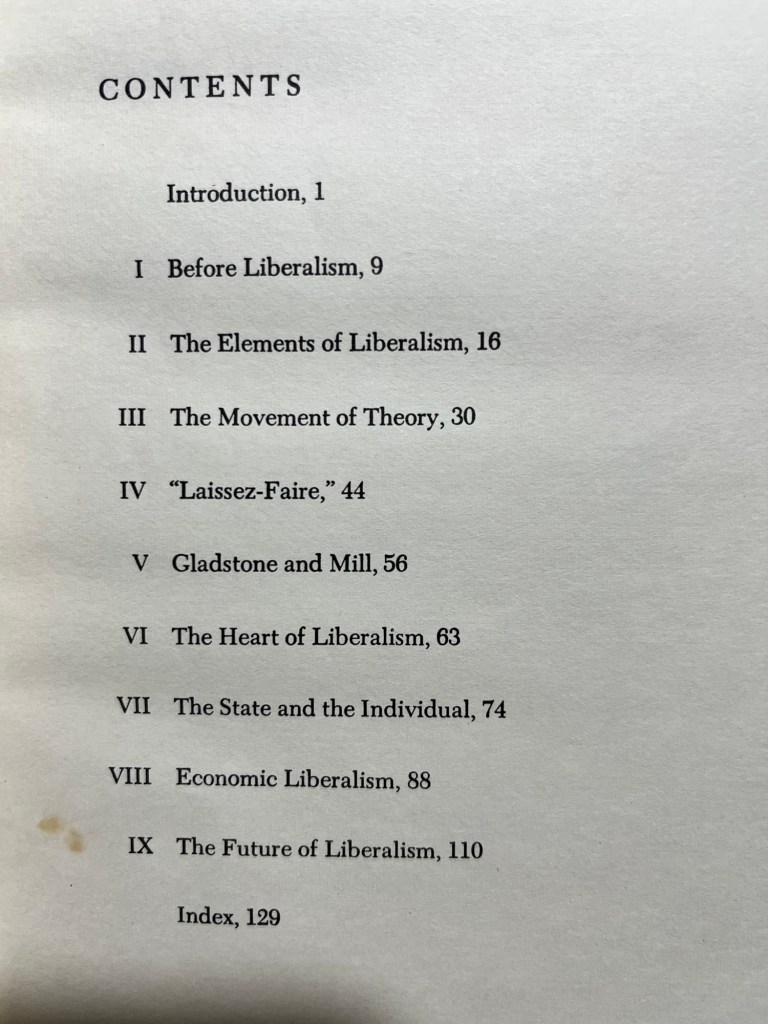
.. When Liberalism was first published in 1911 a critical reviewer in the London Spectator observed, “It would be impossible to have the essential principles of any political creed more clearly stated than they are in this little book.”
In 1897, when Hobhouse was thirty-three years old, he left Oxford [University] to take on a new vocation: editorial writer of the Manchester Guardian. In thus stepping out of the ivory tower and into the world of immediate judgments he took up again a line of interests that he had had earlier as a student. At Marlborough he had been one of the editors of the school paper, the Marlburian; at Corpus [Corpus Christi College²] he had been active in the Pelican Essay Club. As a member of the editorial staff of the Guardian he could join his obvious journalistic abilities with his maturing liberal views.. went back to full-time academic life by accepting an appointment as the first Professor of Sociology at the University of London. He held this position from 1907 until his death in 1929.
“..to integrate a vast body of knowledge into something akin to a comprehensive system of thought which drew upon anthropology for its understanding of the beginnings, worked through psychology, economics, and political science [TOWARD THE PHILOSOPHICALLY DESIRED END OF A HARMONIOUS UNIVERSE.]”
LT Hobhouse FP 1911
John
29042026
2 where he completed his Bachelor of Arts degree in 1887
YARDA YARDA you frankly stupored rich old people who fly their prayer flags and the pre dementia apothegms, aphorisms and adjurations of your Johnson-Carter-Nixon-Reagan largely wasted careers in public office, political clout and money on the enormously self-important @ProSyn 👉🏾👉👉🏿👉🏼 ⤵️
❝ Nevertheless, the expectation that AI will deliver massive productivity gains—and even bigger profits—has proven durable. As Carl Benedikt Frey, María Lombardi, Raghuram G. Rajan, Robin Rivaton, and Dani Rodrik show in a new PS Big Picture, however, there is plenty of reason to doubt this narrat
❝❞
ive❞
wherp-gllyehrpp-nghwhuhlmph those 10k satellites appear to be angry with we techie whizzes hey or it’s Old God. Gulp 😵💫
🥸🥸🥸🥸🥸🥸🥸🥸🥸🥸🥸🥸
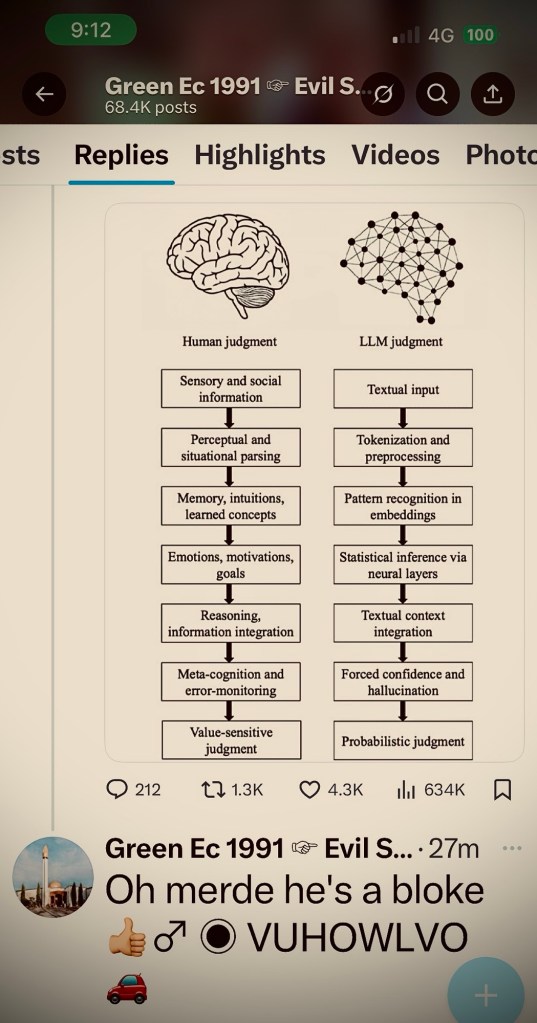
Large language models (LLMs) are widely described as artificial intelligence, yet their epistemic profile diverges sharply from human cognition.
Here we show that the apparent alignment between human and machine outputs conceals a deeper structural mismatch in how judgments are produced.
Tracing the historical shift from symbolic AI and information filtering systems to large-scale generative transformers, we argue that LLMs are not epistemic agents but stochastic pattern-completion systems, formally describable as walks on high-dimensional graphs of linguistic transitions rather than as systems that form beliefs or models of the world.
By systematically mapping human and artificial epistemic pipelines, we identify seven epistemic fault lines, divergences in grounding, parsing, experience, motivation, causal reasoning, metacognition, and value.
We call the resulting condition Epistemia: a structural situation in which linguistic plausibility substitutes for epistemic evaluation, producing the feeling of knowing without the labor of judgment.
We conclude by outlining consequences for evaluation, governance, and epistemic literacy in societies increasingly [ORGANISEDᵛᵛᵛᵛ] around generative AI.
Keywords: Large Language Models, Epistemia, [oink], Judgment, Credibility, Epistemic Alignment
Let me say this clearly: LLMs cannot feel emotions.
Emotions are evolutionary mechanisms. They push us to avoid danger or approach what is beneficial.
We experience emotions because we are alive, and we want to stay alive.
LLMs are not alive.
Yes, emotional language may be encoded somewhere in the LLM. Yes, it may even be associated with some LLM output. But that is just a superficial property.
There is nothing deeper behind it.
For a very simple reason: LLMs do not have an intrinsic and inescapable drive to stay alive.
This is what we call “motivation fault line” in our paper describing seven fault lines between human and artificial intelligence.
* Paper in the first reply
John Blundell, 28 May 2026
the new Neurocognitive-health, Thematics Quantum-relations Logic, the Worldwide Internet Involution, Worldwide Education Reform age 18/12 through 119, the 1995 Concentric ◎\ ◉ -circles Economic Theorem, an extraordinarily (in the spirit of human co-operation, problem-solving, vital ongoing industrial and particularly agricultural development and SCIENCE that’s NOT fake) MODEST $10m compensatory, exemplary (punitive) and aggravated damages payout, IMMEDIATE
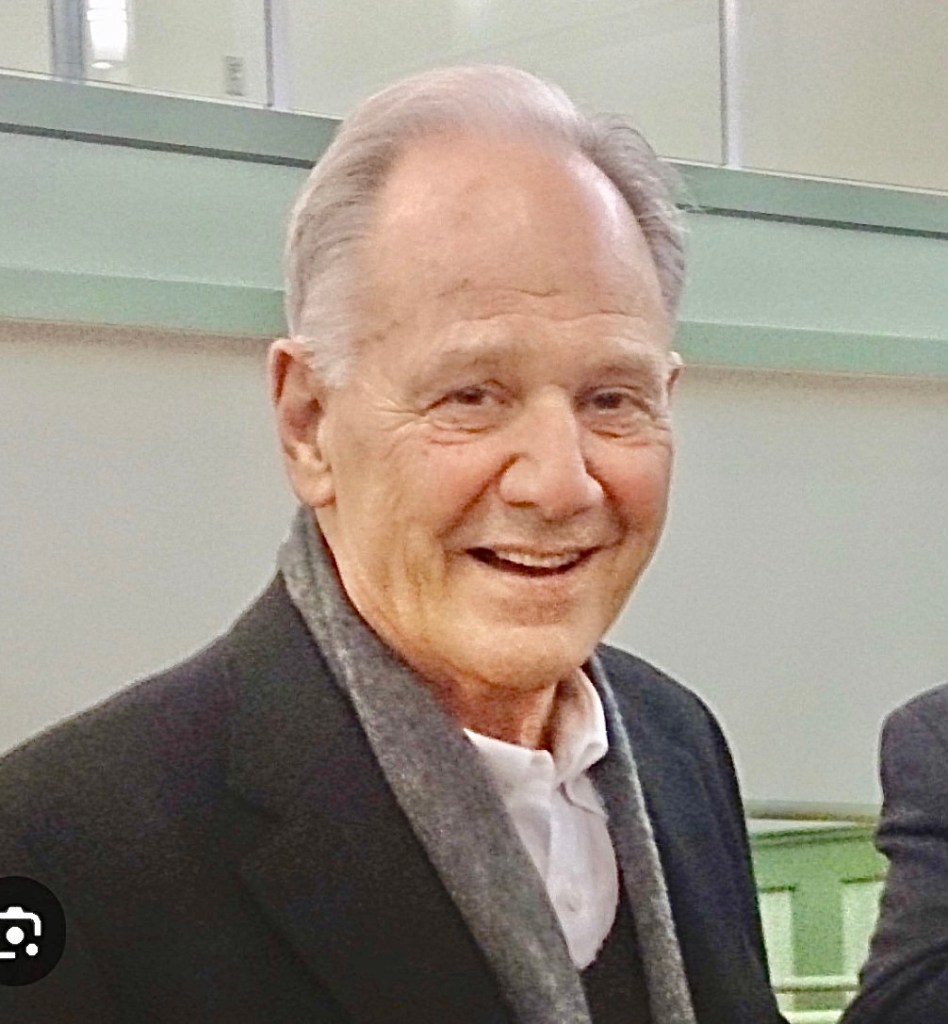
Here is a pic of Gerard Depardiue 4ROM Σ yihirs ago yng ppl
Physicists Begin to See the Problem With AIs
In the foundations of physics, almost all published research is now bullshit: Useless calculations that do not solve any problem, but that are easy enough to perform and — most importantly — publishable. You only have to look at public media coverage to see that there are new “explanations” for dark matter or dark energy every other day, none of which we hear of ever again. If you want to weep, you can scroll through the gr-qc listings, because at this point they are mostly mathematical exercises in modifications of Einstein’s General Relativity that don’t describe our universe.
Of course the people who work in the field will go to lengths to deny the problem and get very upset when I call out their bullshit, but denial won’t work for much longer. The issue is that the current AI systems are now almost good enough to mass manufacture more of these bullshit papers which — going by the miserable quality standard in the field — would merit publication. For the researchers in the field to justify their existence, they will have to significantly raise the quality standard.
You don’t hear a lot of physicists admitting this, but the other week we saw a comment in Nature Astrophysics by Hiranya Peiris who points out that “If a Large Language Model can replicate your scientific contribution, the problem is not the LLM,” and that “The astrophysics literature had a quality problem long before LLMs arrived […] The disease was already present.” He is entirely correct.
Satan showed je suis the 🌐 around in say 0.25 secs up
TEAM
The gags are free though extremely unpopular amongst the great and the good we are therefore dealing expeditiously with the great and the good.
Jonno get this fucking microphone fucking.. ahem\ off 🦘 🇦🇺 🌏 🥸
Dedication of do co\ Jesus Christ\ DOCCO is to Raymond William Sanders dead in the Somme 1916 bro of the late Rev ACL Sanders Australia
The founder of psychoanalysis, Freud (1962), proposed the existence of a tension between the needs of society and the individual. According to Freud, moral development proceeds when the individual’s selfish desires are repressed and replaced by the values of important socializing agents in one’s life (for instance, one’s parents). A proponent of behaviorism, Skinner (1972) similarly focused on socialization as the primary force behind moral development. In contrast to Freud’s notion of a struggle between internal and external forces, Skinner focused on the power of external forces (reinforcement contingencies) to shape an individual’s development. While both Freud and Skinner focused on the external forces that bear on morality (parents in the case of Freud, and behavioral contingencies in the case of Skinner), Piaget (1965) focused on the individual’s construction, construal, and interpretation of morality from a social-cognitive and social-emotional perspective.
Kohlberg (1963) expanded upon Piagetian notions of moral development. While they both viewed moral development as a result of a deliberate attempt to increase the coordination and integration of one’s orientation to the world, Kohlberg provided a systematic 3-level, 6-stage sequence reflecting changes in moral judgment throughout the lifespan. Specifically, Kohlberg argued that development proceeds from a selfish desire to avoid punishment (personal), to a concern for group functioning (societal), to a concern for the consistent application of universal ethical principles (moral).
Turiel (1983) argued for a social domain approach to social cognition, delineating how individuals differentiate moral (fairness, equality, justice), societal (conventions, group functioning, traditions), and psychological (personal, individual prerogative) concepts from early in development throughout the lifespan. Over the past 40 years, research findings have supported this model, demonstrating how children, adolescents, and adults differentiate moral rules from conventional rules, identify the personal domain as a nonregulated domain, and evaluate multifaceted (or complex) situations that involve more than one domain.
For the past 20 years, researchers have expanded the field of moral development, applying moral judgment, reasoning, and emotion attribution to topics such as prejudice, aggression, theory of mind, emotions, empathy, peer relationships, and parent-child interactions.
Piaget’s Theory of Moral Development
To understand adult morality, Piaget believed that it was necessary to study both how morality manifests in the child’s world as well as the factors that contribute to the emergence of central moral concepts such as welfare, justice, and rights. By interviewing children, Piaget (1965) found that young children were focused on authority mandates and that with age, children become autonomous, evaluating actions from a set of independent principles of morality.
He developed two phases of moral development, one common among children and the other common among adults.
Heteronomous Phase
The first is the Heteronomous Phase. This phase, more common among children, is characterized by the idea that rules come from authority figures in one’s life, such as parents, teachers, and God. It also involves the idea that rules are permanent no matter what. Thirdly, this phase of moral development includes the belief that “naughty” behavior must always be punished and that the punishment will be proportional. This absolutism in moral development is seen in children’s play from the age of 5, where they exhibit a blind belief in the rules and ideas of right and wrong passed to them by their elders.
Autonomous Phase
The second phase in Piaget’s theory of moral development is referred to as the Autonomous Phase. This phase is more common after one has matured and is no longer a child. In this phase, people begin to view the intentions behind actions as more important than their consequences. For instance, if a person who is driving swerves in order to not hit a dog and then knocks over a road sign, adults are likely to be less angry at the person than if he or she had done it on purpose just for fun. Even though the outcome is the same, people are more forgiving because of the good intention of saving the dog. This phase also includes the idea that people have different morals and that morality is not necessarily universal. People in the Autonomous Phase also believe rules may be broken under certain circumstances. For instance, Rosa Parks broke the law by refusing to give up her seat on a bus, which was against the law but something many people consider moral nonetheless. In this phase, people also stop believing in the idea of immanent justice.
Kohlberg’s Theory of Moral Development
Psychologist Lawrence Kohlberg (1927–1987) extended upon the foundation that Piaget built regarding moral and cognitive development. Kohlberg, like Piaget, was interested in moral reasoning. Moral reasoning does not necessarily equate to moral behavior. Holding a particular belief does not mean that our behavior will always be consistent with the belief. To develop this theory, Kohlberg posed moral dilemmas to people of all ages, and then he analyzed their answers to find evidence of their particular stage of moral development. After presenting people with this and various dilemmas, Kohlberg reviewed people’s responses and placed them in different stages of moral reasoning. According to Kohlberg, an individual progresses from the capacity for pre-conventional morality (before age 9) to the capacity for conventional morality (early adolescence), and toward attaining post-conventional morality (once formal operational thought is attained), which only a few fully achieve.
Moral Stages According to Kohlberg
Using a stage model similar to Piaget’s, Kohlberg proposed three levels, with six stages, of moral development. Individuals experience the stages universally and in sequence as they form beliefs about justice. He named the levels simply preconventional, conventional, and postconventional.
Figure 9.2.1. Kohlberg identified three levels of moral reasoning: pre-conventional, conventional, and post-conventional: Each level is associated with increasingly complex stages of moral development.
Preconventional: Obedience and Mutual Advantage
The preconventional level of moral development coincides approximately with the preschool period of life and with Piaget’s preoperational period of thinking. At this age, the child is still relatively self-centered and insensitive to the moral effects of actions on others. The result is a somewhat short-sighted orientation to morality. Initially (Kohlberg’s Stage 1), the child adopts an ethics of obedience and punishment —a sort of “morality of keeping out of trouble.” The rightness and wrongness of actions are determined by whether actions are rewarded or punished by authorities, such as parents or teachers. If helping yourself to a cookie brings affectionate smiles from adults, then taking the cookie is considered morally “good.” If it brings scolding instead, then it is morally “bad.” The child does not think about why an action might be praised or scolded; in fact, says Kohlberg, he would be incapable, at Stage 1, of considering the reasons even if adults offered them.
Eventually, the child learns not only to respond to positive consequences but also learns how to produce them by exchanging favors with others. The new ability creates Stage 2, ethics of market exchange. At this stage, the morally “good” action is one that favors not only the child but another person directly involved. A “bad” action is one that lacks this reciprocity. If trading the sandwich from your lunch for the cookies in your friend’s lunch is mutually agreeable, then the trade is morally good; otherwise, it is not. This perspective introduces a type of fairness into the child’s thinking for the first time. However, it still ignores the larger context of actions—the effects on people not present or directly involved. In Stage 2, for example, it would also be considered morally “good” to pay a classmate to do another student’s homework—or even to avoid bullying—provided that both parties regard the arrangement as being fair.
Conventional: Conformity to Peers and Society
As children move into the school years, their lives expand to include a larger number and range of peers and (eventually) of the community as a whole. The change leads to conventional morality, which are beliefs based on what this larger array of people agree on—hence Kohlberg’s use of the term “conventional.” At first, in Stage 3, the child’s reference group are immediate peers, so Stage 3 is sometimes called the ethics of peer opinion. If peers believe, for example, that it is morally good to behave politely with as many people as possible, then the child is likely to agree with the group and to regard politeness as not merely an arbitrary social convention, but a moral “good.” This approach to moral belief is a bit more stable than the approach in Stage 2 because the child is taking into account the reactions not just of one other person, but of many. But it can still lead astray if the group settles on beliefs that adults consider morally wrong, like “Shoplifting for candy bars is fun and desirable.”
Eventually, as the child becomes a youth and the social world expands, even more, he or she acquires even larger numbers of peers and friends. He or she is, therefore, more likely to encounter disagreements about ethical issues and beliefs. Resolving the complexities lead to Stage 4, the ethics of law and order, in which the young person increasingly frames moral beliefs in terms of what the majority of society believes. Now, an action is morally good if it is legal or at least customarily approved by most people, including people whom the youth does not know personally. This attitude leads to an even more stable set of principles than in the previous stage, though it is still not immune from ethical mistakes. A community or society may agree, for example, that people of a certain race should be treated with deliberate disrespect, or that a factory owner is entitled to dump wastewater into a commonly shared lake or river. To develop ethical principles that reliably avoid mistakes like these require further stages of moral development.
Postconventional: Social Contract and Universal Principles
As a person becomes able to think abstractly (or “formally,” in Piaget’s sense), ethical beliefs shift from acceptance of what the community does believe to the process by which community beliefs are formed. The new focus constitutes Stage 5, the ethics of social contract. Now an action, belief, or practice is morally good if it has been created through fair, democratic processes that respect the rights of the people affected. Consider, for example, the laws in some areas that require motorcyclists to wear helmets. In what sense are the laws about this behavior ethical? Was it created by consulting with and gaining the consent of the relevant people? Were cyclists consulted, and did they give consent? Or how about doctors or the cyclists’ families? Reasonable, thoughtful individuals disagree about how thoroughly and fairly these consultation processes should be. In focusing on the processes by which the law was created; however, individuals are thinking according to Stage 5, the ethics of social contract, regardless of the position they take about wearing helmets. In this sense, beliefs on both sides of a debate about an issue can sometimes be morally sound, even if they contradict each other.
Paying attention to due process certainly seems like it should help to avoid mindless conformity to conventional moral beliefs. As an ethical strategy, though, it too can sometimes fail. The problem is that an ethics of social contract places more faith in the democratic process than the process sometimes deserves, and does not pay enough attention to the content of what gets decided. In principle (and occasionally in practice), a society could decide democratically to kill off every member of a racial minority, but would deciding this by due process make it ethical? The realization that ethical means can sometimes serve unethical ends leads some individuals toward Stage 6, the ethics of self-chosen, universal principles. At this final stage, the morally good action is based on personally held principles that apply both to the person’s immediate life as well as to the larger community and society. The universal principles may include a belief in democratic due process (Stage 5 ethics), but also other principles, such as a belief in the dignity of all human life or the sacredness of the natural environment. At Stage 6, the universal principles will guide a person’s beliefs even if the principles mean occasionally disagreeing with what is customary (Stage 4) or even with what is legal (Stage 5).
Video 9.2.1. Kohlberg’s Six Stages of Moral Development explains the stages of moral reasoning and applies it to an example scenario.
Kohlberg and the Heinz Dilemma
The Heinz dilemma is a frequently used example to help us understand Kohlberg’s stages of moral development. How would you answer this dilemma? Kohlberg was not interested in whether you answer yes or no to the dilemma: Instead, he was interested in the reasoning behind your answer.
In Europe, a woman was near death from a special kind of cancer. There was one drug that the doctors thought might save her. It was a form of radium that a druggist in the same town had recently discovered. The drug was expensive to make, but the druggist was charging ten times what the drug cost him to make. He paid $200 for the radium and charged $2,000 for a small dose of the drug. The sick woman’s husband, Heinz, went to everyone he knew to borrow the money, but he could only get together about $1,000, which is half of what it cost. He told the druggist that his wife was dying and asked him to sell it cheaper or let him pay later. But the druggist said: “No, I discovered the drug and I’m going to make money from it.” So Heinz got desperate and broke into the man’s store to steal the drug for his wife. Should the husband have done that? (Kohlberg, 1969, p. 379)
From a theoretical point of view, it is not important what the participant thinks that Heinz should do. Kohlberg’s theory holds that the justification the participant offers is what is significant, the form of their response. Below are some of many examples of possible arguments that belong to the six stages:
Stage one (obedience): Heinz should not steal the medicine because he will consequently be put in prison, which will mean he is a bad person. OR Heinz should steal the medicine because it is only worth $200 and not how much the druggist wanted for it; Heinz had even offered to pay for it and was not stealing anything else.
Stage two (self-interest): Heinz should steal the medicine because he will be much happier if he saves his wife, even if he will have to serve a prison sentence. OR Heinz should not steal the medicine because prison is an awful place, and he would more likely languish in a jail cell than over his wife’s death.
Stage three (conformity): Heinz should steal the medicine because his wife expects it; he wants to be a good husband. OR Heinz should not steal the drug because stealing is bad, and he is not a criminal; he has tried to do everything he can without breaking the law, you cannot blame him.
Stage four (law-and-order): Heinz should not steal the medicine because the law prohibits stealing, making it illegal. OR Heinz should steal the drug for his wife but also take the prescribed punishment for the crime as well as paying the druggist what he is owed. Criminals cannot just run around without regard for the law; actions have consequences.
Stage five (social contract orientation): Heinz should steal the medicine because everyone has a right to choose life, regardless of the law. OR Heinz should not steal the medicine because the scientist has a right to fair compensation. Even if his wife is sick, it does not make his actions right.
Stage six (universal human ethics): Heinz should steal the medicine because saving a human life is a more fundamental value than the property rights of another person. OR Heinz should not steal the medicine because others may need medicine just as badly, and their lives are equally significant.
THINK IT OVER
Consider your decision-making processes. What guides your decisions? Are you primarily concerned with your personal well-being? Do you make choices based on what other people will think about your decision? Or are you guided by other principles? To what extent is this approach guided by your culture?
TRY IT !
☞ John’s note on growing through Symbolic-fn’ ing. Egocentrism, Animism, Centration, Tranductive-reasoning & Irreversibilty followed by ‘age 4 up’ Focus-on-consequences & Absolute-rules ≣
MY THANKS to @Wordpress Cailliff-hornier for enabling the publication in full of the foregoing piece which grew out of a vital examination of how children of say 5 years are LITERALLY INTIMIDATED by psycho-spiritually-challenged or socially impaired (most commonly ex abuse or neglect experiences especially sexually disempowering events suffered by girls in a priapic sexualisation-of-children geo-community) stronger assertive others to insist upon common dyslexic usages as Could-of in lieu of Could-have (more ‘complex’ subjunctive speech that displays a maturing socially operational – NOT primary schooler anodyne mechanical functionality or ‘Navigational’ knowledge of tense, case, number & syntax
AUSTRALIAN UPPER MIDDLE-CLASS LIFE NOT THROUGH THE Saudi-Brussels-Davos-Seoul-Goldmans Hyper-criminal Cabal’s ENGINEERED MACHINE INTELLIGENCE Deep-interiority/ No-spaces BACK 2 FRONT TELESCOPE ᵛ
Alex Miller
Writer dude with his 38 year-old daughter in inner suburban Melbourne one Saturday morning
Clare and I were having our usual coffee.. she reading the newspaper and me staring out the back door at our forlorn garden wondering how I was going to fill my day.. Every now and then Clare read out some snippet of news, then fell silent again. Out of one of these silences, and without looking up from the newspaper, as if she was reading something, she said, ‘He’s probably working up the courage to ask you to read his novel.’
This is the way we conduct our conversations. It took me a moment to wake up to the fact that she was talking about John.
“ ‘A novel about what?’ I said. ‘John’s not a writer.’
“’Has he told you that? About them.’
“’John doesn’t write,’ I said.
“’How do you know?’
“’I can tell. Writers know when there’s another writer around.’
“’Like cats, you mean?’ She laughed and gave me a look..
“’Yes, just like cats,’ I said. ‘You’re looking very smart, darling. I like that outfit. It suits you.’ ”..
‘I have a dread. It’s a father’s dread. It is an image of Clare after I’m gone, sitting here with the newspaper on Saturday morning reading out snippets to Stubby, or his successor. [Becoming the solitary old lady in her father’s house.] If that happens I will have betrayed Marie; I will have betrayed our covenant of love for our little girl. How could I do that? How could I leave our little girl alone in the world? I wanted to ask her if she’d met someone, but I didn’t dare.. It’s true. She’s still my little girl, my child. My daughter. I owe her everything and she owes me nothing. That’s the way I see it. If you bring a child into the world you owe them everything. I’m haunted by my fear that I have failed her in some way and she will be left alone..
‘ ‘Exceptions are always the exception,’ I said. One thing I knew for certain was that John Patterner was no writer. He had never said anything to me about writing, mine, his own, or anyone else’s. He didn’t talk about the books he weas reading. He kept all that to himself. He had never even let on if he’d read any of my books, and I certainly had not asked him – if they’ve read one of your books and liked it, they can’t wait to tell you. And you don’t want to hear the other thing. Writers talk about their stuff all the time. You can’t shut them up. It’s all they ever talk about. There had never been one word from John on the subject of writing. John was the quiet type, as all true readers are. Keeping their imaginary worlds to themselves. Except when..
‘A writer can’t arbitrarily decide what to write. [We can only do what is offered to us.] What comes our way. I like to call it a conversation with the unconscious. Following the prompts of the imagination. [But these prompts must offer themselves freely. They won’t be forced. That’s the nature of the gift. It’s what we mean when we say people are gifted. They receive the prompts, and they follow them. Not everyone is so prompted, and not everyone who is so prompted follows them.] [But contrary to common belief, writing is not a solitary pursuit; it is always a conversation.]
‘A story will suddenly get a grip, and there it is, a deeper resonance, and you wake in the night thinking about it. I hadn’t reached that stage yet with John’s story, not yet. Perhaps I never would. [But it was out there. It was a possibility.] It had happened to me before..
‘Writing and telling are very different fish. My father was a great storyteller who never wrote a word in his life. [The writer cruises the ocean currents, and often comes to grief out there. The writer who loses his way in what Christina Stead called the ocean of story. It happens all the time. we drown out there. We go under. A familiar voice falls silent and is never heard from again. The Mary Celestes of the writing world.] It’s not something you can calculate. The loss is mysterious and puzzling. The teller, on the other hand, keeps to a familiar stretch of the river and remains safe.’
John
^ a John Blundell Comm-ec Australia Worldwide zinger of say – all library, files and papers stolen by Australian politicians, bikies, spooks & maddies – 1994 (an excellent year for creatives, authors, police sergeants & scholars getting on with their studies & publishing)
this is exactly why I moved back to china and I genuinely think most people reading this from the west have no idea what it actually feels like to build here
the thing about shenzhen that changed everything for me is the access, makerspaces everywhere open to anyone, components available in any quantity at any hour, hardware meetups and deeptech demo nights happening every single day where founders show up with actual physical prototypes & get torn apart by engineers who’ve been shipping products for 20y
+++ investor sessions where VCs ask about your thermal dissipation strategy before they ask about yourt revenue, the density of ambitious people building physical things in one city is something I’ve never experienced anywhere else on earth
and the education pipeline feeding all of this is staggering, chinese kids start building robots & programming microcontrollers in middle school as part of the national curriculum by high school they’re doing projects in machine vision& embedded systems
tsinghua, USTC & zhejiang these universities produce researchers who go from publishing a paper to founding a startup with gov backed seed funding in a matter of months…
the pipeline from fundamental research to applied engineering to company creation is seamless here in a way that would make any european researcher cry
and what most people in the west completely miss is the role of the tech giants as ecosystem builders, juawei alibaba, tencent & baidu are operating as deeptech accelerators at a scale that has 0 equivalent in the west
huawei alone runs the ascend AI ecosystem where they give hardware startups access to their custom AI chips their toolchains& their cloud infrastructure for free or near free so founders can build on top of chinese silicon instead of depending on NVIDIA
alibaba’s academy funds and incubates in quantum computing chip design and autonomous driving then plugs them directly into alibaba cloud’s customer base & tencent invests in robotics companies and connects them to its manufacturing partners
these aren’t passive financial investors writing checks from SF, they’re active ecosystem architects who provide silicon compute distribution channels & manufacturing access in a single integrated package
Q1 numbers that just dropped tell the whole story, 5% GDP growth driven almost entirely by hightech manufacturing, integrated circuit production up 49.4% in a single quarter under maximum US sanctions, electronic materials up 32.5%, lithium battery output up 40.8%…
the 4 AI chip startups they call the « four dragons» moore threads, metaX, biren & enflame all going public simultaneously valued at billions, huawei rolling out a 3y roadmap to overtake NVIDIA & the deeptech VCs here write checks with a technical depth I’ve rarely seen anywhere
these are people who read your papers who understand your architecture at the gate level who challenge your engineering choices on EMI coupling & power stage layout before they even look at your market
I genuinely think think the sanctions have been the greatest unintentional R&D program in history, they forced China to build in 5y what would have taken 20 without them, and now the country is sitting on a self sufficient semiconductor ecosystem, a dominant position in clean energy tech, a manufacturing base that operates like a collective intelligence network and an education system that produces millions of engineers who see building physical things as the highest form of ambition
meanwhile the west is spending trillions on a war in the middle east and debating whether AI needs another ethics committee
I know where I want to be and it’s here
this is exactly why I moved back to china and I genuinely think most people reading this from the west have no idea what it actually feels like to build here
the thing about shenzhen that changed everything for me is the access, makerspaces everywhere open to anyone, components available in any quantity at any hour, hardware meetups and deeptech demo nights happening every single day where founders show up with actual physical prototypes & get torn apart by engineers who’ve been shipping products for 20y
+++ investor sessions where VCs ask about your thermal dissipation strategy before they ask about yourt revenue, the density of ambitious people building physical things in one city is something I’ve never experienced anywhere else on earth
and the education pipeline feeding all of this is staggering, chinese kids start building robots & programming microcontrollers in middle school as part of the national curriculum by high school they’re doing projects in machine vision& embedded systems
tsinghua, USTC & zhejiang these universities produce researchers who go from publishing a paper to founding a startup with gov backed seed funding in a matter of months…
the pipeline from fundamental research to applied engineering to company creation is seamless here in a way that would make any european researcher cry
and what most people in the west completely miss is the role of the tech giants as ecosystem builders, juawei alibaba, tencent & baidu are operating as deeptech accelerators at a scale that has 0 equivalent in the west
huawei alone runs the ascend AI ecosystem where they give hardware startups access to their custom AI chips their toolchains& their cloud infrastructure for free or near free so founders can build on top of chinese silicon instead of depending on NVIDIA
alibaba’s academy funds and incubates in quantum computing chip design and autonomous driving then plugs them directly into alibaba cloud’s customer base & tencent invests in robotics companies and connects them to its manufacturing partners
these aren’t passive financial investors writing checks from SF, they’re active ecosystem architects who provide silicon compute distribution channels & manufacturing access in a single integrated package
Q1 numbers that just dropped tell the whole story, 5% GDP growth driven almost entirely by hightech manufacturing, integrated circuit production up 49.4% in a single quarter under maximum US sanctions, electronic materials up 32.5%, lithium battery output up 40.8%…
the 4 AI chip startups they call the « four dragons» moore threads, metaX, biren & enflame all going public simultaneously valued at billions, huawei rolling out a 3y roadmap to overtake NVIDIA & the deeptech VCs here write checks with a technical depth I’ve rarely seen anywhere
these are people who read your papers who understand your architecture at the gate level who challenge your engineering choices on EMI coupling & power stage layout before they even look at your market
I genuinely think think the sanctions have been the greatest unintentional R&D program in history, they forced China to build in 5y what would have taken 20 without them, and now the country is sitting on a self sufficient semiconductor ecosystem, a dominant position in clean energy tech, a manufacturing base that operates like a collective intelligence network and an education system that produces millions of engineers who see building physical things as the highest form of ambition
meanwhile the west is spending trillions on a war in the middle east and debating whether AI needs another ethics committee
I know where I want to be and it’s here
🌐💲🥸💲❓💲🥸💲🥸💲❓🥸
That was a very interesting little essay and our thanks from Australia











 Billionaire-🙈🙊🙉🐒s with Olivettis