..a world- and society-kindly, balanced, moderate, nuanced statement from an authentic scholar [..transcript from the ever-curious if not psycho-spiritually lost New Statesman our readers will find valuable]
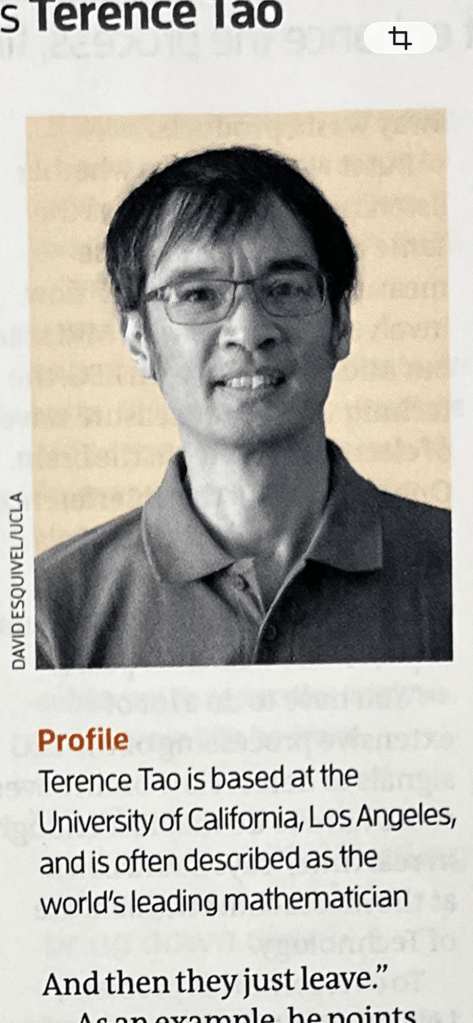
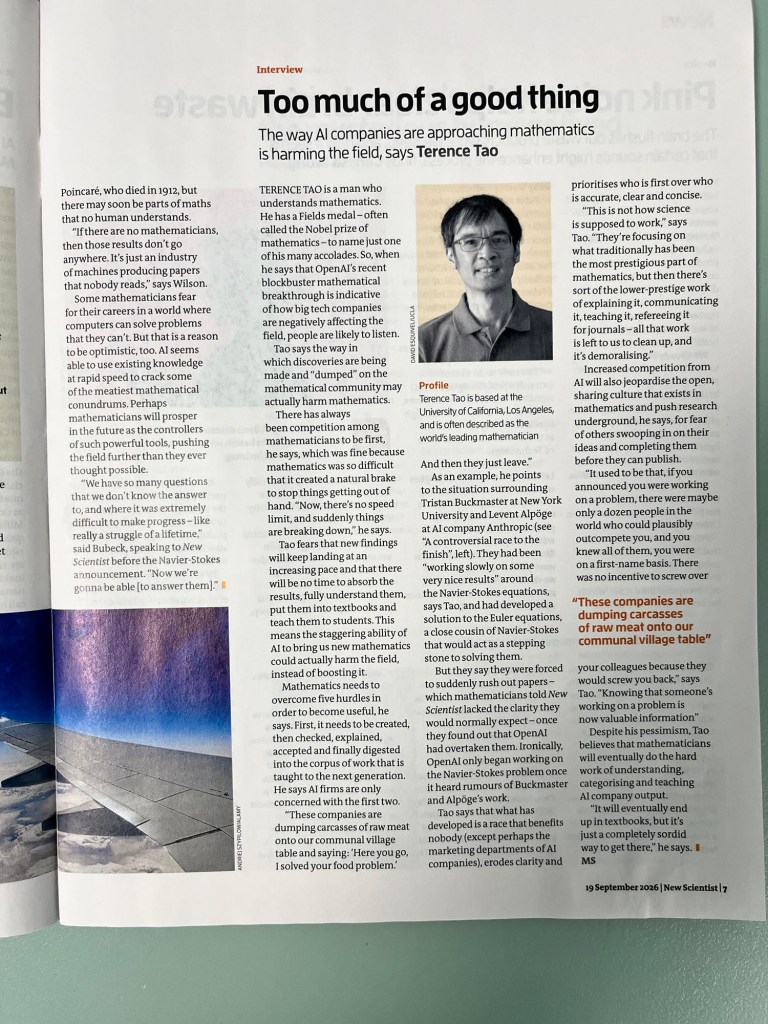
Terence Tao is a man who understands mathematics. He has a Fields medal – often called the Nobel prize of mathematics – to name just one of his many accolades. So, when he says that OpenAI’s recent blockbuster mathematical breakthrough is indicative of how big tech companies are negatively affecting the field, people are likely to listen.
Tao says the way in which discoveries are being made and dumped on the mathematical community may actually harm mathematics.
There has always been competition among mathematicians to be first, he says, which was fine because mathematics was so difficult that it created a natural brake to stop things getting out of hand. “Now, there’s no speed limit, and suddenly things are breaking down,” he says.
Tao fears that new findings will keep landing at an increasing pace and that there will be no time to absorb the results, fully understand them, put them into textbooks and teach them to students. This means the staggering ability of AI to bring us new mathematics could actually harm the field, instead of boosting it.
Mathematics needs to overcome five hurdles in order to beome useful, he says. First, it needs to be created, then checked, explained, accepted and finally digested into the corpus of work that is taught to the next generation. He says AI firms are only concerned with the first two.
These companies are dumping carcasses of raw meat onto our communal village table and saying: ‘Here you go, I solved your food problem.’ And then they just leave.
As an example, he points to the situation surrounding Tristan Buckmaster at New York University and Levent Alpoge at Ai company Anthropic.. They had been “working slowly on some very nice results” around the Navier-Stokes e quations says Tao, and had developed a solution to the Euler equations, a close cousin of Navier-Stokes that would act as a stepping stone to solving them.
But they say they were suddenly forced to rush out papers – which mathematicians told New Scientist lacked the clarity they would normally accept – once they found out that OpenAI only began working on the Navier-Stokes problem once it heard rumours of Buckmaster and Alpoge’s work.
Tao says that what has developed is a race that benefits nobody (except perhaps the marketing departments of AI companies), erodes clarity and prioritises who is first over who is accurate, clear and concise.
“This is not how science is supposed to work,” says Tao. “They’re focusing on what traditionally has been the most prestigious part of mathematics. but then there’s sort of the lower-prestige work of explaining it, communicating it, teaching it, refereeing it for journals – all that work is left for us to clean up, and it’s demoralising.”
Increased competition wil also jeopardise the open, sharing culture that exists in mathematics and push research underground, he says, for fear of others swooping in on their ideas and completing them before they can publish.
It used to be that, if you announced you were working on a problem, there were maybe only a dozen people in the world who could plausibly outcompete you, and you knew all of them, you were on a first-name basis. There was no incentive to screw over your colleagues because they would screw you back,’ says Tao. Knowing that someone’s working on a problem is now valuable information.”
Despite his pessimism, Tao believes that mathematicians will eventually do the hard work of understanding, categorising and teaching AI company output.
“It will eventually end up in textbooks, but it’s just a completely sordid way to get there,” he says.
MS 19 September 2026 l New Scientist
Courtesy Billionaire Monkeys with Typewriters and the now famous @Xcomms account since 2012 @greeneconomyact. Also JohnBlundell3 @Substack for Philosophy AND Science emphasis amongst the bewildered & confused of consciousness and the actual purposes & all-interlocking systems of Life on Earth
Directionless under the leadership of Science-triumphalist/ ‘Perma-war’/ Landlord Class & Trades Union movement multi-millionaire ENVIRONMENTALLY BLIND politicians effective vassal state of the United States of America Australia
JOHN