• “Mercantilism is a state-driven, nationalistic economic model focused on accumulating wealth (gold/silver) via trade surpluses and regulation, prevalent from the 16th to 18th centuries.”
• “Capitalism is a system based on private ownership, free markets, and profit maximization, driven by voluntary exchange and innovation.”
• “Now what’s cooler than bein’ cool? (ICE COLD!) I can’t hear ya’ I say what’s cooler than bein’ cool? (ICE COLD!) … Now I wanna see y’all on y’all baddest behavior, Lend me some suga’, I am your neighbor”. (..on the album Speakerboxxx/The Love Below 2001)
• Chomsky explains how first the education system and then the mainstream media filter journalists for ‘obedience and subordination.’ (1996)
• Chomsky replies, ‘I am not saying you’re self-censoring. I’m sure you believe everything you’re saying. But what I’m saying is that if you believed something different, you wouldn’t be sitting where you’re sitting’ (1996)
That stuff ➸
‘The school of Cobden is affiliated in general outlook both to the doctrine of natural liberty and to the discipline of Bentham. It shared with the Benthamites the thoroughly practical attitude dear to the English mind. It has much less to say of natural rights than the French theorists. On the other hand, it is saturated with the conviction that the unfettered action of the individual is the mainspring of all progress1 .. ..
‘ 1 “If I were to sum up in a sentence the difference and the connection (between the two schools) I would say that the Manchester men were the disciples of Adam Smith and Bentham, while the Philosophical Radicals followed Bentham and Adam Smith” ( FW Hirst, The Manchester School, Introd. p 21)
‘The Corn Laws, as even the tax reformers of our own day admit, were conceived in the interest of the governing classes. They frankly imposed a tax on on the food of the masses for the benefit of the landlords, and as the result of the agricultural and industrial revolutions which had been in progress since 1760, the masses had been brought to the lowest point of economic misery. Give to every man the right to buy in the cheapest and sell in the dearest market, urgedthe Cobdenites, [AND TRADE WOULD AUTOMATICALLY EXPAND.] ..
‘The business career would be open to the talents. The good workman would command the full money’s worth of his work, and his money would buy him food and clothing at the lowest rate in the world’s market. ..
‘Only so would he get the full value of his work, paying toll to none. Taxes there must be to carry on government, but if we looked into the cost of government we found [THAT IT DEPENDED MOSTLY ON ARMAMENTS]. Why did we need armaments? First, because of the national antagonisms aroused and maintained by a protective system. ..
‘Free commercial intercourse betwen nations would engender mutual knowledge, and knit the several peoples by countless ties of business interests. Free Trade meant peace, and once [TAUGHT BY THE EXAMPLE OF GREAT BRITAIN’S PROSPERITY], other nations would follow suit, and Free Trade would be universal. ..
‘The other root of national danger was the principle of intervention. We took it on ourselves to set other nations right. How could we judge for other nations? Force was no remedy. Let every people be free to work out its own salvation. Things were not so perfect with us that we needed to go about setting the houses of other people in order. ..
‘To complete personal freedom, there must be national freedom. There must also be colonial freedom.. They were distant lands, each, if we gave it freedom, with a great future of its own, capable of protecting itself , and developing with freedom into true nationhood. [PERSONAL FREEDOM, COLONIALFREEDOM, INTERNATIONAL FREEDOM, WERE PARTS OF THE ONE WHOLE.]
‘Non-intervention, peace, restriction of armaments, retrenchment of expenditure, reduction of taxation, were connected series of practical consequences. The money retrenched from wasteful military expenditure need not all be remitted to the taxpayer. A fraction of it devoted to education – free, secular, and universal – would do as much good as when spent on ships and guns it did harm. For education was necessary to raise the standard of intelligence, and provide the substantial equality of opportunity at the start without which the nass of men could not make use of the freedom given by the removal of legislative restrictions..
The Writer ☞
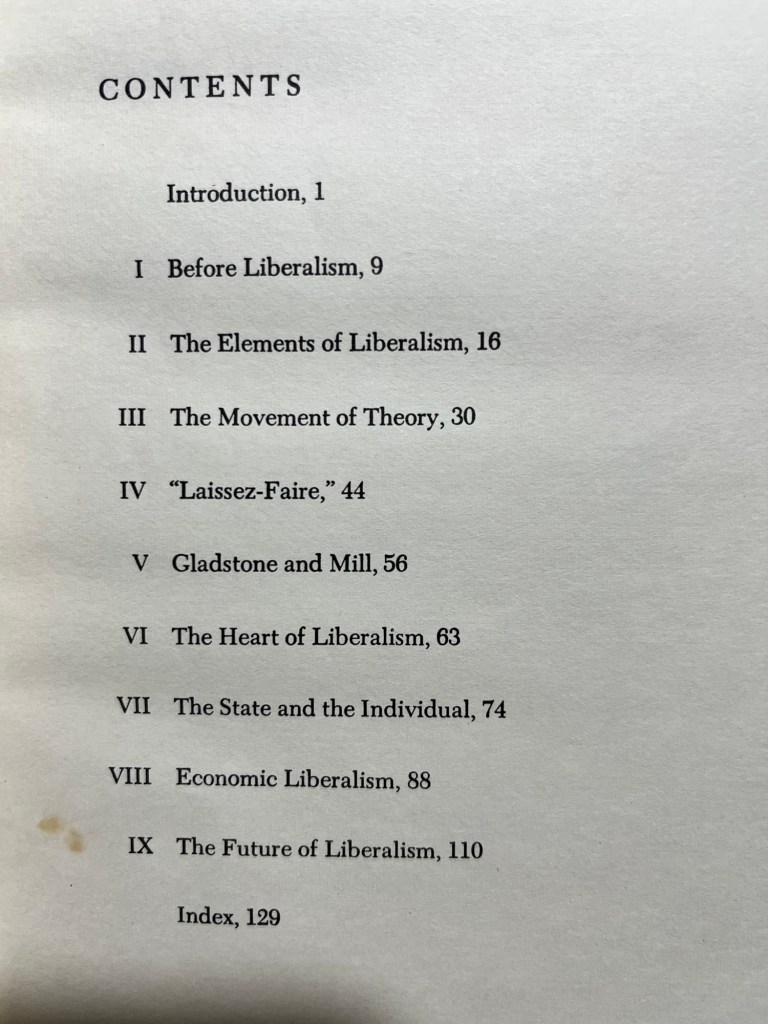
.. When Liberalism was first published in 1911 a critical reviewer in the London Spectator observed, “It would be impossible to have the essential principles of any political creed more clearly stated than they are in this little book.”
In 1897, when Hobhouse was thirty-three years old, he left Oxford [University] to take on a new vocation: editorial writer of the Manchester Guardian. In thus stepping out of the ivory tower and into the world of immediate judgments he took up again a line of interests that he had had earlier as a student. At Marlborough he had been one of the editors of the school paper, the Marlburian; at Corpus [Corpus Christi College²] he had been active in the Pelican Essay Club. As a member of the editorial staff of the Guardian he could join his obvious journalistic abilities with his maturing liberal views.. went back to full-time academic life by accepting an appointment as the first Professor of Sociology at the University of London. He held this position from 1907 until his death in 1929.
“..to integrate a vast body of knowledge into something akin to a comprehensive system of thought which drew upon anthropology for its understanding of the beginnings, worked through psychology, economics, and political science [TOWARD THE PHILOSOPHICALLY DESIRED END OF A HARMONIOUS UNIVERSE.]”
John
29042026
2 where he completed his Bachelor of Arts degree in 1887

