
YARDA YARDA you frankly stupored rich old people who fly their prayer flags and the pre dementia apothegms, aphorisms and adjurations of your Johnson-Carter-Nixon-Reagan largely wasted careers in public office, political clout and money on the enormously self-important @ProSyn 👉🏾👉👉🏿👉🏼 ⤵️
❝ Nevertheless, the expectation that AI will deliver massive productivity gains—and even bigger profits—has proven durable. As Carl Benedikt Frey, María Lombardi, Raghuram G. Rajan, Robin Rivaton, and Dani Rodrik show in a new PS Big Picture, however, there is plenty of reason to doubt this narrat
❝❞
ive❞
wherp-gllyehrpp-nghwhuhlmph those 10k satellites appear to be angry with we techie whizzes hey or it’s Old God. Gulp 😵💫
🥸🥸🥸🥸🥸🥸🥸🥸🥸🥸🥸🥸
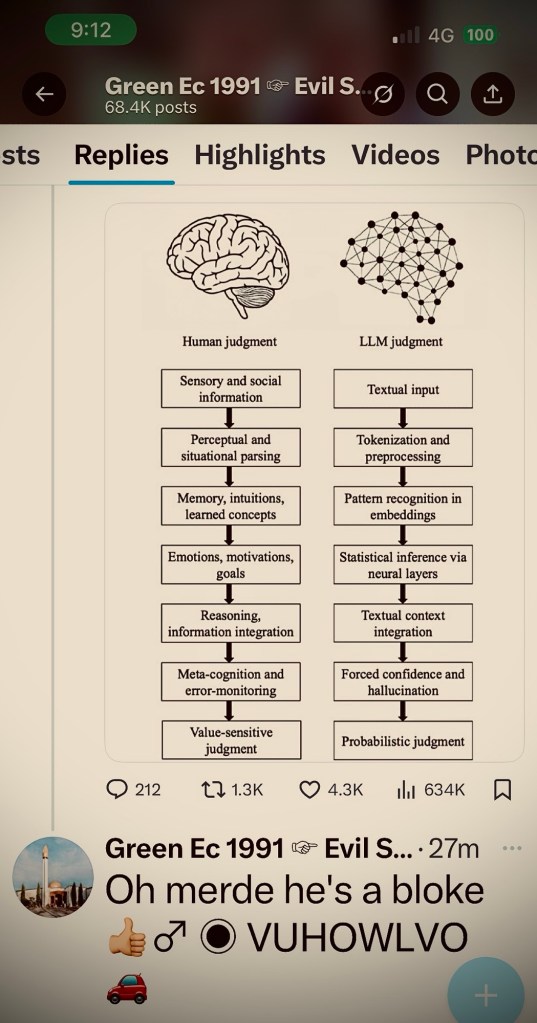
Large language models (LLMs) are widely described as artificial intelligence, yet their epistemic profile diverges sharply from human cognition.
Here we show that the apparent alignment between human and machine outputs conceals a deeper structural mismatch in how judgments are produced.
Tracing the historical shift from symbolic AI and information filtering systems to large-scale generative transformers, we argue that LLMs are not epistemic agents but stochastic pattern-completion systems, formally describable as walks on high-dimensional graphs of linguistic transitions rather than as systems that form beliefs or models of the world.
By systematically mapping human and artificial epistemic pipelines, we identify seven epistemic fault lines, divergences in grounding, parsing, experience, motivation, causal reasoning, metacognition, and value.
We call the resulting condition Epistemia: a structural situation in which linguistic plausibility substitutes for epistemic evaluation, producing the feeling of knowing without the labor of judgment.
We conclude by outlining consequences for evaluation, governance, and epistemic literacy in societies increasingly [ORGANISEDᵛᵛᵛᵛ] around generative AI.
Keywords: Large Language Models, Epistemia, [oink], Judgment, Credibility, Epistemic Alignment
This chick x.com/ValerioCapraro/st… ♀ω➽ wrote etorw ☚♀❦
Oh merde he’s a bloke


◉ VUHOWLVO

Pahpa John,


–

–

-You-essay

Let me say this clearly: LLMs cannot feel emotions.
Emotions are evolutionary mechanisms.
They push us to avoid danger or approach what is beneficial.
We experience emotions because we are alive, and we want to stay alive.
LLMs are not alive.
Yes, emotional language may be encoded somewhere in the LLM.
Yes, it may even be associated with some LLM output.
But that is just a superficial property.
There is nothing deeper behind it.
For a very simple reason: LLMs do not have an intrinsic and inescapable drive to stay alive.
This is what we call “motivation fault line” in our paper describing seven fault lines between human and artificial intelligence.
*
Paper in the first reply
John Blundell, 28 May 2026
the new Neurocognitive-health, Thematics Quantum-relations Logic, the Worldwide Internet Involution, Worldwide Education Reform age 18/12 through 119, the 1995 Concentric ◎\ ◉ -circles Economic Theorem, an extraordinarily (in the spirit of human co-operation, problem-solving, vital ongoing industrial and particularly agricultural development and SCIENCE that’s NOT fake) MODEST $10m compensatory, exemplary (punitive) and aggravated damages payout, IMMEDIATE
⁶⁶⁶literally REGULATED, MANAGED, RUN & CONTROLLED

