A Large Chunk 4ROM @adam_tooze Friday with 3 Person Expert Panel @ALJazeera @ALJazeera Audio “thrown in,” Team

At this beginning and at the end below but not in the middle I joyfully – joie joie joie – acknowledge my debt – well Billionaire Typing Monkeys1 does – to Chartbook. – We all drive, strive3 to become as life the engenderer and revitaliser of worlds.

“Apropos the questions “Do we know what time it is?” and “How do we actually inhabit the global condition?”, I’ve been preoccupied these last few weeks by how little the world that I am in, is talking about Bangladesh.

“I started thinking about Bangladesh regularly after writing a section of Shutdown on the impact of COVID on the global garment sector, a sector in which Bangladesh plays a pivotal role. Bangladesh is the 8th most populous country in the world. In the last half century and particularly in recent decades it is one of the great development success stories. Bangladesh has often been touted as a story of pro-poor-growth driven above all by NGOs. This graphic from the Economist is typical of the genre. From a desperately low level in 2000, it shows Bangladesh overtaking first Pakistan and then India in GDP per capita.

“Bangladesh is the 8th most populous country in the world. In the last half century and particularly in recent decades it is one of the great development success stories. Bangladesh has often been touted as a story of pro-poor-growth driven above all by NGOs. This graphic from the Economist is typical of the genre. From a desperately low level in 2000, it shows Bangladesh overtaking first Pakistan and then India in GDP per capita.Bangladesh is one of the most-climate exposed “big” country in the world. As the IMF reported back in 2019, by 2050, Bangladesh will lose 17% of its territory due to rising sea levels, resulting in the loss of 30% of the country’s agricultural land.On August 5 2024, barely a month ago, a student-led revolution toppled the elected authoritarian regime of Sheikh Hasina and rather than celebrating this fact (or denouncing it), the really eerie thing is that it is as though nothing happened. Check out FT, Foreign Affairs, Foreign Policy etc to see how minimal the reaction has been. I’m really grateful to Cam Abadi and the Foreign Policy for giving us the space to talk about Bangladesh on the pod a few weeks back

“Your audio..


“Why Are Food Prices Surging?.. It was good to engage with the news on the show, but tbh I’ve remained haunted ever since.What does it mean that this dramatic upheaval can be happening in this huge and important country and “we” are largely oblivious? The only conversations I have had about Bangladesh other than with Cam are with Uber drivers in Manhattan. They were generally in a buoyant mood.Returning to the question of the last newsletter: Are we actually capable of inhabiting our reality in this moment? Are we actually capable of being in medias res?The question has become all the more urgent for me as I’ve read more about Bangladeshi history and realized the extent to which Bangladesh was present in global discourse half a century ago, at the time of independence in 1971.Upgrade to paidOf course, you might say that we are simply overwhelmed. Our modern world is so much more complex. There were 3.7 billion people on the planet in 1971. Now there are 8.2 billion. We are flooded with impressions and news. But looking at the case of Bangladesh then and now I can’t help fearing that a further problem is that our channels of information are less capable of delivering informed and sophisticated reactions to events. Does that reflect the fact that the West is less curious and less engaged? Has the West become provincialized also in that sense?I am sure there are serious ways of assessing those kinds of questions. I’m too over-extended right now to do anything more than to record my dismay and puzzlement and to offer in this newsletter a few things I have learned about Bangladesh in recent weeks that strike me as particularly interesting. I am going to focus on the founding crisis of the country in the late 1960s and 1970s, which is both utterly fascinating from a historical point of view and topical because it was a proposal to introduce quotas to favor descendants of veterans of 1971 that triggered the student uprising.

“#1 elementary fact: One tends to assume that new nations that “break away” will be smaller in population than the states from which they split. In the Pakistani case in 1971 the reverse was the case.The lopsided construction of Pakistan in 1947 joined together two predominantly Muslim regions of the Raj, regardless of the huge ethnic and cultural differences that divided East Pakistan (Bangladesh) from the West (modern Pakistan). It also created a strange mismatch of demography, economics and political influence. According to the 1961 census, politically dominant West Pakistan, where the military had their center of power, had a population of 42 million. At the same time, East Pakistan was estimated to have a population of 50 million. So when democratization was attempted and the Bengali Awami League established its hegemony in East Pakistan, they held the majority in the joint Pakistani parliament, a fact that both the West Pakistani military leadership and the elected leaders in West Pakistan were unwilling to concede.

“#2 Surprise: In the 1960s, under military rule, Pakistan was widely touted as highly successful growth models. This gave the East Pakistani leadership resources and authority both at home and abroad. But it also sowed seeds of division.Under the authoritarian, modernizing leadership of General Ayub Khan (1958-1969), Pakistan was touted as one of the original “Asian tigers” . Crucially, West Pakistan accelerated far ahead of its great rival India.This growth was fueled by exceptionally high levels of foreign aid in the 1960s, which, as is true of aid generally, has attenuated since. Pakistan today, despite its strategic significance, its huge population and urgent needs receives far less aid as a share of GDP from a far richer world than it did in the 1960s.Source: World BankBut that ultra rapid growth in the 1960s, also intensified the disparities between two parts of Pakistan, with West Pakistan seeing much larger investment and growth and East Pakistan lagging relatively speaking behind.Source: Industrial Policy In PakistanThis was particularly galling because the Bengali economy of East Pakistan was historically one of the region’s great export engines and its earnings continued to fill the coffers of the Pakistani state.

“#3 Student protest was widespread across the globe in “1968”. But nowhere was it more consequential than in Bangladesh where an East Pakistani student movement, effectively challenged West Pakistani rule, setting the stage for a national uprising and the formation of an independent Bangladesh.You would never know this from standard accounts of 1968, which focus on campuses in the West. It is a point ably made by Srinath Raghavan in his indispensable study of the global politics of 1971.This interview is a great accompaniment to his crucial book.There is an excellent essay by Samantha Christiansen on the culture and politics of student protest in Bangladesh which has striking echoes in the present.

“In 1968, of course, students were causing headaches for government leaders far beyond Pakistan’s national borders and regional scale. While newspapers were under strict censorship and were limited in their ability to run stories about the activities of anti-government activity in Pakistan, they were free to report on the activities of students elsewhere, and they did so in high volume. In fact, in the Pakistan Observer for the year of 1968, student uprisings dominate the coverage, occupying as much attention as the Vietnam War. There was also a weekly column reporting on student political uprisings entitled “The Angry Young World” which ran articles on a variety of uprisings. The sense from reading these dailies was of a world being turned upside by youth revolt; thus, even though the papers did not have any stories regarding student activity in Pakistan, they fomented a spirit of youth political agency through reportage on other arenas, and created an international scale into which students at Dhaka University could place themselves. These newspaper stories provided the linkage of Dhaka University students with the larger “imagined community” of the youth in the Global Sixties (Anderson 1991; Zolov 1999). Of particular interest was the rising young star in the British New Left, Tariq Ali. … 

“The brutal assassination of Asad uz Zamman, a student at Dhaka University and a well-known political activist on campus, had a profound mobilizing effect on the movement. The student community was affected deeply and personally by the death of such a popular and prominent member of the campus. A gruesome image of his dead body just after being shot, with blood pouring from the back of him was printed on the cover of virtually every newspaper the next morning, and SAC declared three days of mourning on his behalf. Students gathered the morning after the death and raised Asad’s bloodied shirt onto a pole. Thousands of students gathered in mourning for their fallen comrade. Tofail Ahmad recalls, “At that day, we took an oath that Asad’s death would not be in vain. He was one of us—not just a Bengali—a student of Dhaka University, truly one of us. We felt a sadness deep in our bellies” (Personal interview 2010). Asad was declared a martyr by the students. A well circulated poem for the martyred Asad, captures the mood of the students

Like bunches of blood-red Oleander
Like flaming clouds at sunset
Asad’s shirt flutters In the gusty wind, in the limitless blue.
To the brother’s spotless shirt
His sister had sown
With the fine gold thread
Of her heart’s desire
Buttons which shone like stars;
How often had his ageing mother,
With such tender care,
Hung that shirt out to dry In her sunny courtyard.
Now that self-same shirt
Has deserted the mother’s courtyard,
Adorned by bright sunlight
And the soft shadow
Cast by the pomegranate tree,
Now it flutters
On the city’s main street,
On top of the belching factory chimneys, In every nook and corner
Of the echoing avenues,
How it flutters
With no respite In the sun-scorched stretches
Of our parched hearts,
At every muster of conscious people
Uniting in a common purpose.
Our weakness, our cowardice
The stain of our guilt and shame-
All are hidden from the public gaze
By this pitiful piece of torn raiment
Asad’s shirt has become
Our pulsating hearts’ rebellious banner.

“#4 As the crisis escalated in 1971 and the Pakistani military cracked down with massive force, the mass killings directed at the political opposition but also the Hindu minority in East Pakistan, were soon described both on the spot and in the global media as a genocide and comparisons to the Holocaust were drawn.Down to the present day, Pakistani and Bangladesh researchers and propagandists debate the question of “3 million” victims. Al Jazeera made this attempt at a summary in the context of war crimes trials staged by Sheikh Hasina’s regime in the 2010s.What is beyond question is that there was a vast and deliberate massacre. This resulted in a gigantic refugee exodus to India. It was seen as a matter of international concern that went beyond questions of internal affairs and national sovereignty. And it attracted worldwide attention on that basis.Thanks to the archive of Youtube, fifty years later, we can watch both original TV reports, concerns and engaged poetry from the period, which give a vivid impression of how the crisis was seen in living rooms around the world.As amongst news reporting from 1971 on youtube two have so far stood out for me: This comprehensive report by Dateline Bangladesh on Youtube I am using this awkward link because the content is truly graphic and Youtube won’t permit a direct link.This ITN compilation gives an eye-opening insight into post-colonial British coverage.

“#5 The role of the Nixon administration and Kissinger in particular has been widely discussed. The protests to Washington by the staff at the US Consulate in Dhaka at the violence they were witnessing went unacknowledged. It was to be a formative moment for ethical discourse within the US foreign service. Gary Bass’s book is a vital reminder of all this.But apart from its callousness. The singularity of US policy is brought out even more clearly by Raghavan’s comparative global treatment of the crisis, which shows how the US was the only major global player whose diplomacy ignored the regional context of the Bangladesh crisis and reduced it, to the exclusion of all else, to a brutal Cold War logic of my enemy’s enemy. What Washington was interested in, to the exclusion of all else, was using Pakistan as a conduit to Beijing, with a view to outplaying the Soviet Union. Ironically, on Raghavan’s reading both the Soviet Union and China took a more sophisticated view of the crisis. The subversive implication is that Kissingerian realism was not just ethically barbarous. In its reduction of the crisis to a logic of simple geopolitics, it was not so much realistic as simply crude and one-dimensional.

“#6 The indignation in the West at the scale of the massacres in Bangladesh and Western complicity in them, sparked a truly dramatic mobilization of pop culture.This was more short-lived than the mobilization around the civil rights movement and Vietnam. But in the reach of its global imagination the mobilization for Bangladesh in 1971 was impressive and still stirs a chord. This report on the famous Concert for Bangladesh headlined by George Harrison and Ravi Shankar in Maddison Square Garden, is remarkable viewing.Joan Baez did a beautiful tribute for Bangladesh in her own quieter style. For those with a strong stomach you may also wish to savor Allen Ginsberg’s memorial to the refugee treks on Jessore Road.What is striking about these contributions is not necessarily their artistic quality, but three things. The strong sense of global engagement. Secondly, the insistence on the rhetoric of “millions” to convey the sheer scale of the violence and the exodus and the association with the Holocaust. And finally, the sense of excitement and novelty you hear in people’s voices as they pronounce the name of a new nation – Bangladesh. As Wikipedia explains, it is a typical creation of modern nationalism conjuring ancient roots.The etymology of Bangladesh (“Bengali country”) can be traced to the early 20th century, when Bengali patriotic songs, such as Aaji Bangladesher Hridoy by Rabindranath Tagore and Namo Namo Namo Bangladesh Momo by Kazi Nazrul Islam, used the term in 1905 and 1932 respectively.[26] Starting in the 1950s, Bengali nationalists used the term in political rallies in East Pakistan.

“#7 Following independence, the new nation of Bangladesh was born into intense crisis. It was massively dependent on India, which did not hesitate to exploits its new leverage. Amidst the oil price and food price shocks of the early 1970s, Bangladesh was one of the weakest links. It suffered an accelerating inflation in 1972-3, which issued into a full blown famine in 1974. This too left deep marks on national politics and the Bangladeshi development model.Bangladesh from the 1980s onwards would become one of the key laboratories for new forms of development finance, notably in the form of the Grameen bank and its model of microfinance. This fascinating book by Naomi Hossain argues that this Bangladeshi success story is rooted in the traumatic shocks that accompanied the birth of the new state in the early 1970s.From an unpromising start as ‘the basket case’ to present-day plaudits for its human development achievements, Bangladesh plays an ideological role in the contemporary world order, offering proof that the neo-liberal development model works under the most testing conditions. How were such rapid gains possible in a context of chronically weak governance? The Aid Lab subjects this so-called ‘Bangladesh paradox’ to close scrutiny, evaluating public policies and their outcomes for poverty and development since Bangladesh’s independence in 1971. Countering received wisdom that its gains owe to an early shift to market-oriented economic reform, it argues that a binding political settlement, a social contract to protect against the crises of subsistence and survival, united the elite, the masses, and their aid donors in the wake of the devastating famine of 1974. This laid resilient foundations for human development, fostering a focus on the poorest and most precarious, and in particular on the concerns of women. In chapters examining the environmental, political, and socioeconomic crisis of the 1970s, the book shows how the lessons of the famine led to a robustly pro-poor growth and social policy agenda, empowering the Bangladeshi state and its non-governmental organizations to protect and enable its population to thrive in its engagements in the global economy. Now a middle-income country, Bangladesh’s role as the world’s laboratory for aided development has generated lessons well beyond its borders, and Bangladesh continues to carve a pioneering pathway through the risks of global economic integration and climate change.There is no neat conclusion to this list of points. I simply hope that it is useful and that I find the time, energy and headspace to keep adding to it.”

..this is how we boogie in world politics

John Blundell

The New Neurolinguistics
Post Socratic 5 part Quantum-relations Logic
Post Neoclassical Philosophy & Raison-d’etat Geopolitics
Post Neoliberal Economy
Now mercifully ‘post’ having my life & times & property stolen from me by Australian political thugs


Australia


1 greeneconomyaction.com ( not wired4weld,com, that account name got Disappeared by Breitbart News, the Daily Beast, the Betoota Advocate, those zany Australian Broadcasting Corporation private schoolboys, Mark Zuckerberg or Hunter Biden or some shit )

2 ‘I love writing Chartbook. I am delighted that it goes out for free to tens of thousands of readers around the world. What supports this activity are the generous donations of active subscribers. Click the button below to see the standard subscription rates.Upgrade to paidYou’re currently a free subscriber to Chartbook. For the full experience, upgrade your subscription.Upgrade to paid LikeCommentRestack © 2024 Adam Tooze
548 Market Street PMB 72296, San Francisco, CA 94104
Unsubscribe‘

3 – but not swive: the dramatic ancient Greek clown-figures of this three-quarters broken world are now flatly required to pull themselves together

@Adam_Tooze today

I love writing Chartbook. I am delighted that it goes out for free to tens of thousands of readers around the world. What supports this activity are the generous donations of active subscribers. Click the button below to see the standard subscription rates.

Chartbook 312 Hezbollah’s shadow bank and Lebanon’s disaster capitalism.

ADAM TOOZE

AUG 26, 2024

.. the risk not only of Israeli bombardment, but of total economic collapse. Whatever the world price of oil, they will struggle to afford any. 

The latest symptom of escalating economic stress to catch my eye was the report that Algeria is scrambling emergency deliveries of fuel oil to Lebanon to prevent a total collapse of the country’s electricity supply. As Bloomberg reports: 

Electricite Du Liban said that the last remaining production unit of the Zahrani power plant has been “forcibly shut down” and that the blackout will affect the country’s airport, ports, water pumps, sewage systems and prisons, state-run National News Agency 

This leaves better-off Lebanese relying on generators. Those need fuel that can normally only be procured for hard currency. For most Lebanese that is in desperately short supply. Even if the Algerian oil makes it to Lebanon, it is far from clear how the locals will pay for it. 

Upgrade to paid

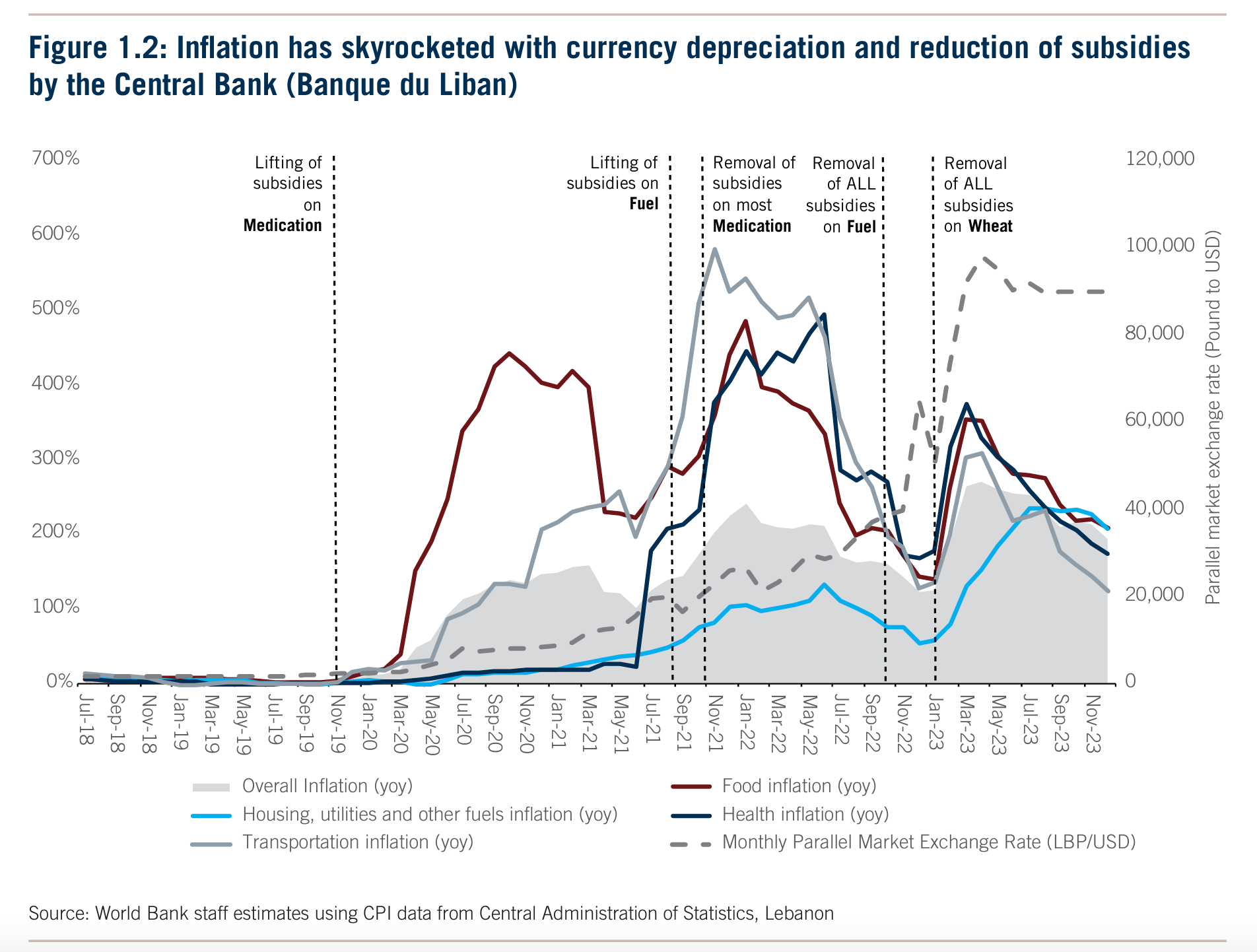
To reduce a once-prosperous country like Lebanon to these dire straits takes more than a single shock. It takes more than a single catastrophe, even if it has the epic force of the Beirut blast of 2020. It takes more than a war, even one as costly as that with Israel in 2006. It is the result of multiple converging forces that go back to the civil war of the 1970s and 1980s and the sectarian power-sharing deal that followed, forces that paralyzed reconstruction after 2006 and gave Hezbollah a decisive role in parliament in 2018. Lebanon’s problems were compounded by the fiasco of Western policy in Iraq and after 2011 by the disastrous civil war in Syria, which drove millions to seek refuge in Lebanon. As dysfunction multiplied, water supplies failed, garbage went uncollected, wildfires raged without government response and bankruptcy approached, in the autumn of 2019 Lebanon entered a phase of open crisis. Street protests and impending default triggered capital flight and an accelerating collapse in the currency. Meanwhile, the government decision to slash subsidies and raise taxes hiked the cost of living. As the World Bank describes the spiraling disaster:

The sharp deterioration of the Lebanese pound, which lost 98 percent of its pre-crisis value by December 2023, propelled inflation to new heights. With imports constituting about 60 percent of the consumption basket (World Bank, 2022), the plunging currency led to triple-digit inflation which rose steeply from an annual average of 3 percent between 2011 and 2018, to 85 percent in 2019, 155 percent in 2020, and 221 percent in 2023. Inflationary pressures were exacerbated by the rise in global food prices since the war in Ukraine and Lebanon’s heavy reliance on wheat imports, along with the destruction of its strategic wheat reserves in the August 2020, Beirut port explosion. … inflation was consequently even more dramatic, skyrocketing from 4 percent in 2019 to 254 percent in 2020 and has remained in triple-digits through 2023. Faced with falling foreign exchange reserves, the government withdrew subsidies on medication, fuel, and wheat further fueling rising costs of healthcare and transport (Figure 1.2). 

Back in 2021 I described this conjuncture as the West Asian polycrisis.

Under the impact of these shocks, the Lebanese economy began not only to inflate but to fall apart. There were desperate shortages of basics including water, power and the closure of the banking system. In a surreal twist Lebanese resorted to armed robbery to liberate their own money from elite-controlled banks.

In the spring of 2020 Lebanon failed to make payments on $32 billion of international bonds. The Lebanese political class did not have the will to enter into serious negotiations with its creditors, resulting in a “hard default”. As the crisis escalated, it was revealed that without government approval the financial elite had used the accounts of the central bank to support Lebanon’s private banks, to the tune of tens of billions of dollars. 

As the currency plunged, prices soared and the banking system shut down, normal economic activity collapsed. In purchasing power parity terms, the World Bank estimates that GDP per capita has fallen by 45 percent.

This is one of the most dramatic implosions ever suffered by a modern economy.  In July 2022, the World Bank downgraded Lebanon’s status from upper-middle income country, a position it had held for almost 25 years, to lower middle income country

At the bottom of the income pyramid, poverty has surged. As the World Bank describes it: 

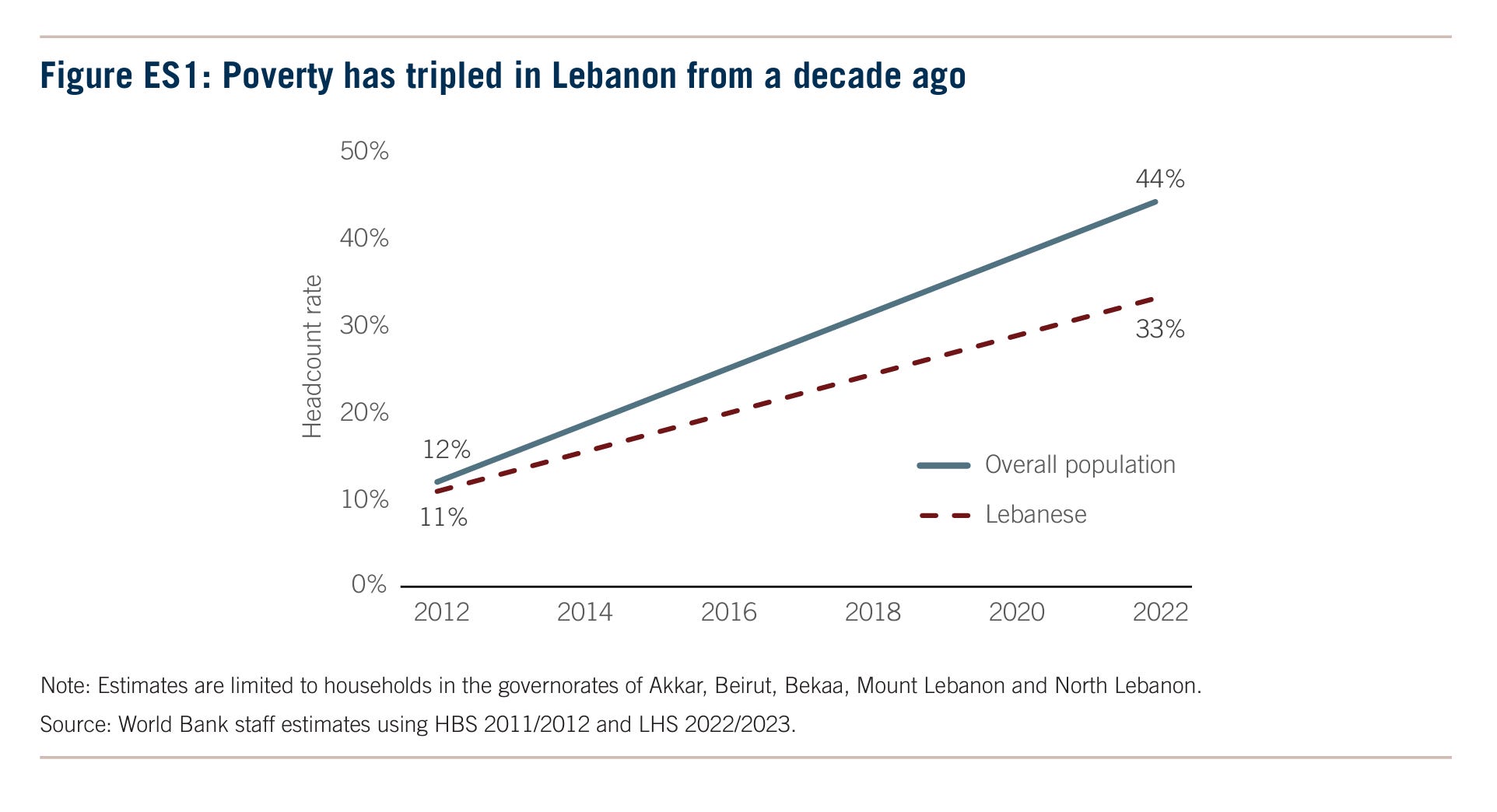
Monetary poverty in Lebanon has more than tripled from over a decade ago. New survey data2 covering the population residing in five governorates of Akkar, Beirut, Bekaa, North Lebanon and most of Mount Lebanon reveal a rise in consumption-based poverty in the covered areas from 12 percent in 2012 to 44 percent in 2022.3 Among the Lebanese residing in these five governorates, one out of every three individuals was poverty-stricken in 2022, up from 11 percent in 2012.4 Not only has the share of poor Lebanese increased, but they are also falling deeper into poverty. The depth of their poverty or poverty gap—which is the minimum financial amount required to bring the spending levels of the poor up to the poverty line, expressed as a share of the latter—rose from 3 percent in 2012 to 9.4 percent in 2022. A new, unofficial poverty line was developed for 2022 to better reflect the consumption behavior of households amidst the ongoing economic crisis. The existing national poverty line is outdated as it relies on consumption patterns from 2012 that no longer reflect the realities and conditions faced by households in Lebanon today. Overall prices have increased by nearly 15 times over the past decade, eroding the purchasing power of lira-denominated incomes. Survey data also reflects this change in consumption patterns – Lebanese households in 2022 residing in the covered governorates are consuming a third of the amount of (mostly imported) meat and seafood from a decade ago while the consumption of more affordable bread and cereals has risen by over 20 percent.

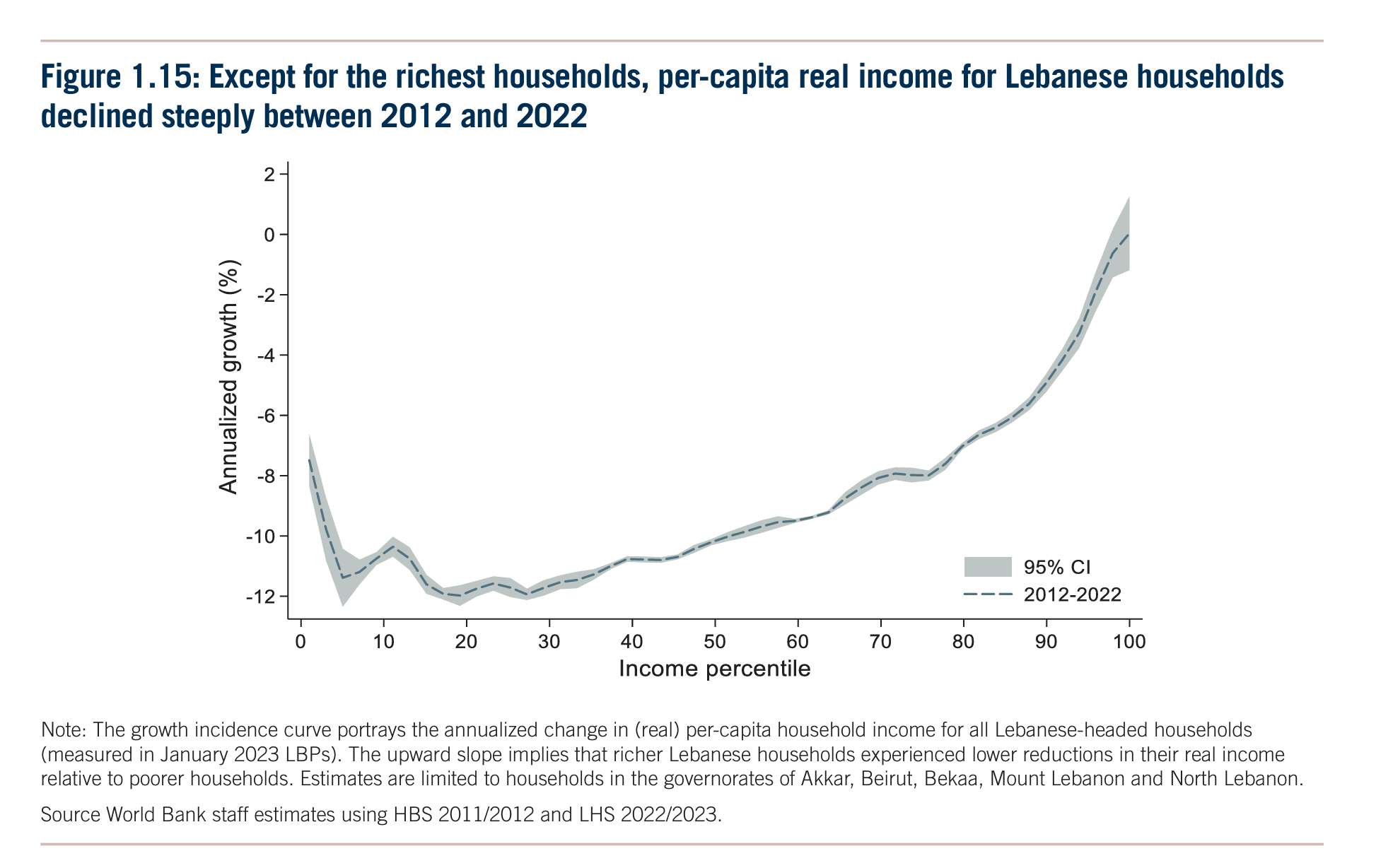
Rapid inflation acted effectively as a highly regressive tax, striking hardest at the poor and those with fixed, lira-denominated incomes. Lebanon has increasingly become a cash-based dollarized economy, which works to the benefit of those getting paid in a foreign currency. The size of the dollar-denominated cash economy is estimated to have increased from 26 percent in 2021 to around 46 percent of GDP in 2022 (World Bank, 2023a). Dollarization of the economy can be an impediment to economic growth as it raises the risk of money laundering, informality, and tax evasion (World Bank, 2024a). However, individuals who earn partially or fully in dollars are insulated from the loss of purchasing power induced by the sharply depreciating currency.

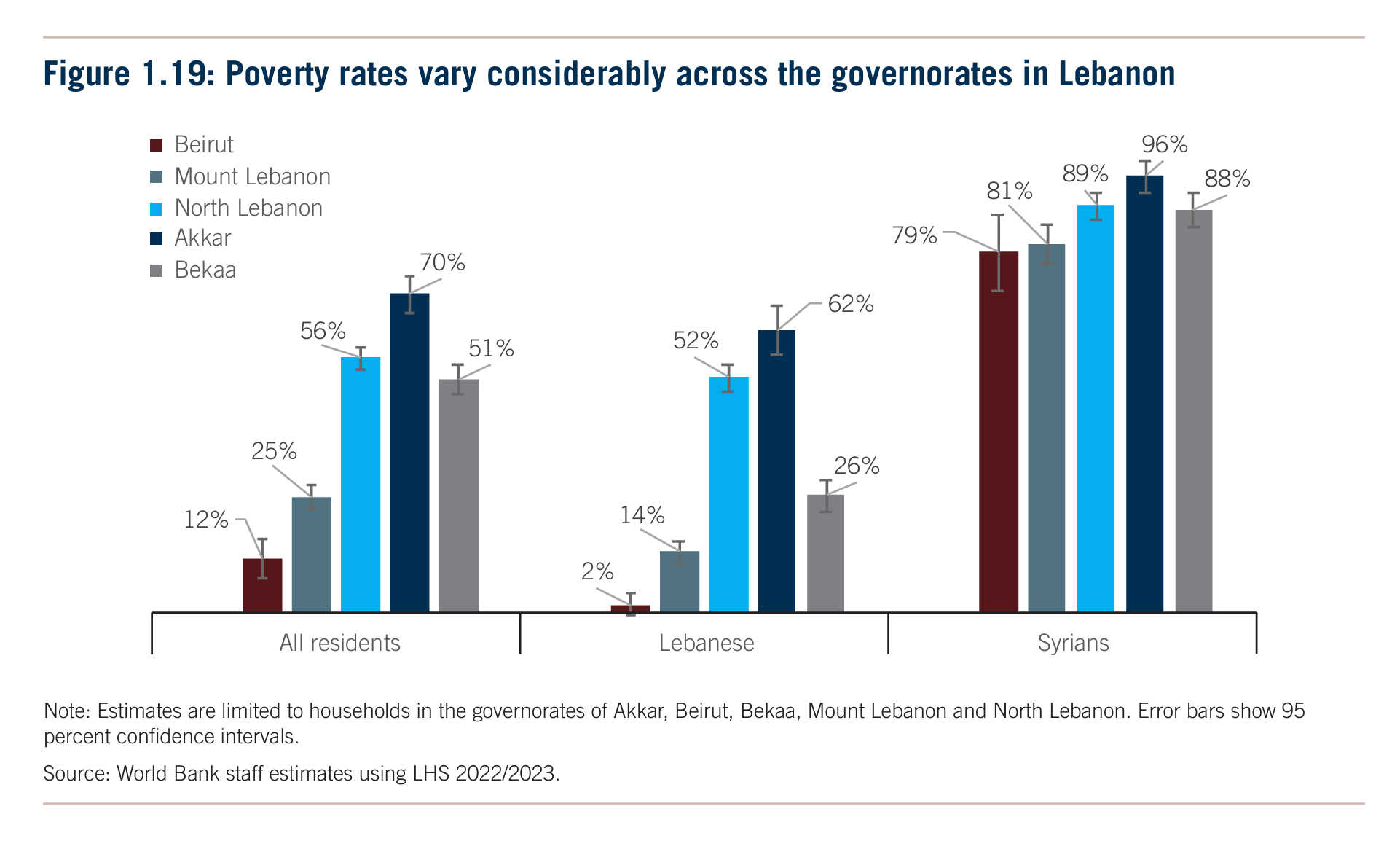
Apart from position in the income distribution, the fate of Lebanese is decided by where they live in the country. Beirut is relatively well protected compared to the Northern provinces where poverty is rife. In much of the territory no data can be collected. But what is clear is that the direst emergency is that facing the millions of Syrians who fled to Lebanon to escape the civil war. Amongst the refugee population, poverty rates stand at over 80 percent.

Earlier this year, the EU mobilized a new support package offering support to the tune of $1.06bn, but that money is directed, as the EU openly insists, towards the support of refugees notably from Syria. What is on Europe’s mind is the possibility of another migrant crisis, not the welfare of the Lebanese themselves. Unsurprisingly, resentment towards the refugees has become an easy topic for Lebanon’s failed political class to exploit. In a cynical act of scapegoating the Lebanese state has begun forcibly deporting thousands of Syrians.

Meanwhile, the Lebanese parliament in a grotesque act of self-dealing in January 2024 passed a budget that promised to close the budget deficit of 12.8 of GDP by raising regressive value-added tax whilst decreasing the progressive taxes levied on capital gains, real estate and investments. For lack of reforms, the IMF is refusing to disburse any of the $3bn package that are allocated to Lebanon.

The strategy of Lebanon’s relatively well-insulated elite seems to be to wait out the crisis hoping that in due course foreign donors will recognize that they have to provide support even in the absence of reform. Meanwhile, the on-going crises leave Lebanese with no option but to rely on the social and political forces that over the last decades have created the disastrous status quo. The most powerful of these is Israel’s antagonist Hezbollah. 

Hezbollah is famous for entrenching its power in an elaborate social infrastructure of Islamic welfare. The social grip of those structures and services is increased by the ongoing crisis of the Lebanese economy. When the medical service fails, desperate families turn to the Hezbollah-run health service.

Subsidies from Iran help to sustain the Hezbollah operation in Lebanon. They are reckoned to amount to hundreds of millions of dollars per annum, far larger than anything Iran has ever provided to Hamas.

But Hezbollah is not merely an Iranian influence operation. It is deeply embedded in what is left of the Lebanese economy. 

The escalating crisis in Lebanon since 2019 has stirred political opposition against Hezbollah. But it has also made Hezbollah’s infrastructure even more important for everyday life.

To give one critical example, the failure of central electricity supply makes local government and privately operated generators into key suppliers. As Samara Azzi and Hanin Ghaddar report electrical supply becomes political in the most direct sense:

the two Shia parties own the generator networks in Beirut’s southern suburbs and the country’s south. It does not cover the Baalbek-Hermel area, but local observers confirm the same trend there.52 Generator networks are run in one of three ways in Hezbollah-controlled areas: (1) They are owned and operated by the municipalities—which are typically controlled by Hezbollah (or Amal) members.53 (2) The party works through an individual to run the network as a private enterprise, even as the investment and profits consist mostly of Hezbollah cash. Or (3) they operate through a “private-public partnership” involving the municipality and private actors. Whichever the arrangement, the infrastructure and funding come from the “Party of God” and ultimately benefit Hezbollah operations. Unsurprisingly, the individuals and their companies are usually fronts for Hezbollah, or parts of its business network.54

Since the collapse of the Lebanese financial system in 2020, the Hezbollah-controlled financial firm known as al-Qard al-Hasan Association, or AQAH has expanded from paying Hezbollah’s army and officials to supplying liquidity to the wider Lebanese economy. 

As one recent report described its operations:

In 2021, several of AQAH’s branches began installing ATMs that dispense large sums of Lebanese pounds and U.S. dollars to borrowers. Borrowers can withdraw as many dollars as they want and renew loans indefinitely, so long as they provide the collateral of gold, whose value is currently at an all-time high. Although there have been reports of gold confiscations in response to defaults, these cases are limited due to the negative impact this would have on Hezbollah’s public image. Instead, Hezbollah tends to hold onto the depositor’s gold while offering the option of renewing loans against it indefinitely upon repayment.

Want to set up a small business? AQAH will make you a loan. Want to answer the power crisis by installing cheap Chinese solar panels? Hezbollah controls the imports and it will be happy to provide you with financing.

Under US sanctions since 2007, Hezbollah’s shadow bank operates at arms length from the officially licensed and regulated banking system. It relies on a network of front operations and helpful connections in friendly Arab states. It may be cumbersome and rudimentary in its techniques. But, all told, it boasts of providing billions of dollars in loans to Lebanon’s families and small businesses.

Many of the loans are secured against gold, meaning that Hezbollah has become an aggregator of savings and assets, on the basis of which it can make rotating loans. To get its hands on dollars, Hezbollah, with the consent of local financial interests, operates a network of exchange shops. As Azzi and Ghaddar explain, Hezbollah exists not in isolation but in mutually beneficial cooperation with Christian business interests in Lebanon:

In the Lebanese cash economy, Hezbollah’s Christian allies control the foreign remittance services and the hard currency coming from abroad, while Hezbollah and Amal actors run the foreign exchange houses, and the internal transfer market— which deals mainly with payment to government ministries—is controlled by former Zgharta mayor Mouawad. This three-way setup ensures the financial health of the Hezbollah-Amal-Bassil axis—which in turn relies on BDL, the facilitator of a highly corrupt process, and the Ministry of Finance, the collector of payments and the distributor of contracts to internal transfer companies. 

Hezbollah has friends not just in Teheran but in Baghdad too. Iraq’s foreign exchange regulations allow tourist travel schemes to be exploited to shuffle dollars into Lebanon. 

A further source of revenue comes from Hezbollah’s connections to the Captogen drug-running schemes that have become a key pillar of the Iran-backed Assad regime in Syria. 

Even further afield, investigations by the US authorities have exposed a set of connections between Hezbollah and the Syrian and Lebanese diaspora in South America and particularly in Venezuela. Most recently these networks appear to have been trading Iranian oil for Venezuelan gold, which is hoarded by the financial authorities in Teheran. As a result in 2000 Washington labeled Hezbollah not only as a terrorist organization, but as a transnational criminal organization along with MS-13 and the major Mexican cartels. 

I’m in no position to judge the plausibility of these, at times, surreal seeming claims. Are there really Hezbollah-aligned clans dotting the Atlantic coastline of Venezuela? 

The Atlantic Council thinks so, and what that means for Lebanon is that there is not just a war with Israel to worry about, but the Damocles sword of the Paris-based Financial Action Task Force (FATF. As Politico’s Matthew Karnitschnig reports the global financial watchdog may be on the brink of grey-listing Lebanon:

In the coming weeks it (FATF) is expected to place Lebanon on its “gray list” of wayward jurisdictions and determine what reforms the country would have to implement in order to receive a good bill of health and avoid FATF’s dreaded “blacklist.” Though FATF — which was set up by the G7 in 1989 and has since grown to include dozens of members from around the world — has no formal enforcement powers, its evaluations can have a chilling effect on a nation’s ability to operate in the world of international finance. … Officials familiar with FATF’s investigation, who spoke to POLITICO on the condition they not be named, said Lebanon would normally be an open and shut case, given how egregious the evidence of money laundering and terror financing in the country is. … Yet the broader dynamic in both Lebanon and the Middle East has complicated things. To begin with, Hezbollah’s influence over Lebanon’s core institutions means its central government is unable to enforce even the most basic international money laundering norms. An even bigger problem, the western diplomats said, is that several countries in the region, including Bahrain and Libya, have locked arms with Lebanon in opposing international regulators’ push for a crackdown, making it all but impossible to effectively target Hezbollah’s illicit financing. 

Whether the current escalation of tension results in full-scale warfare, one thing is for sure: the imbrication of politics and everyday life goes far too deep to be extirpated through bombing, shelling or assassination. 


Upgrade to paid

54 Likes

·

8 Restacks

20 Comments

Kouros

10 hrs ago

I don’t think Lebanon is more corrupt than other countries.

The problem with Lebanon is that for Israel to feel secure, everything around needs either be crashed (all republics) or made totally subservient (all kingdoms). The words sanctions appears only once in the post. One sees similar analyses about Venezuela, for instance, with its economy on the doldrums, analyses that never report on the sanctions imposed by the US. 

Iraq is blackmailed to support US presence and abide by some US diktates by having all its oil proceeds forced through New York banks and blocked in case of disobedience.

But the last sentence indicates the failings of western policies towards Lebanon and the wider area: “Whether the current escalation of tension results in full-scale warfare, one thing is for sure: the imbrication of politics and everyday life goes far too deep to be extirpated through bombing, shelling or assassination.” But this will not stop with an Israel in the chockehold of a rabid ethnonationalistic frenzy. Maybe somebody should have a serious talk with Israel? Would solve a lot of problems in the area…

REPLYSHARE

12 replies

Keith Resnick

Keith’s Substack

5 hrs ago

I am a secular American living in Israel. Can any of you please explain why Hezbollah has been launching missiles at Israel for the past 10 months? Are we fighting over land? Have innocent Lebanese civilians been forced out of Israel? It sounds like all of you are followers of Iran; America is the Great Satan and Israel the Little Satan. Poor Lebanon, it would be the jewel of the world were it not for Israel. Pity those Iranians, if only Israel didn’t exist, there would not have been an Islamic revolution. and Yemen, oh great and wonderful Yemen. Israel is the reason it has not progressed in, well, ever. 

This story should have ended the day Israel beat back 6 Arab armies in 1948. You lose a war, the spoils go to the victor. Instead, the Arabs and their sympathizers (most of the commentators here) decided to rewrite the definition of “refugee”, which incomprehensibly remains in effect to this day (again, thanks to the support of yourselves). Since several of you do not like Capitalism, perhaps you would prefer to live under the thumb of the Chinese or the Soviets? Ask the Eastern Europeans how much they loved 4 decades of oppressive Communism. 

REPLYSHARE

18 more comments…

Liberal Democracy Crashing Worldwide

..4ROM and brought 2U by MONKEYS ex Community Economist Publications Worldwide 1996 through to 2003 when the writer quit for a bit as he realised and wrote and published that we were all headed for a fossil-fuels burning business-as-usual heating ‘bio-meltdown’ by 2032

@wired4weld as accessible to a readership (downloadable presumably – I think – do I care, No-nein-нет) and published that is to suggest uploaded per my super-cheap Ruslan Kogan ‘Vodie=vibes’ – Australian comedy, baby-talk and dad jokes no we don’t normally do Australian comedy, poo jokes and stuff people at the Bloo-ie E/ p’s Broad & Bloke Casting Corporation get paid $120 thousand a year to pump out – TOTALLY Richard Branson-free thankfully greeneconomyaction.com – if you like the Pentagon and the evil mediaeval Central Intellgence Agency only ever read what you want to read for your perverted prurient vacuous pleasure then we really do have news for you.

“AI analysed 1,500 policies to cut emissions.”

Izzuhnt AI extraordinarily useful to Man\ What a piece of work is man/ how noble in his execution of the most complex sensorimotor tasks anyone ever dreamed of or saw a @YouTube video a @TedTalk or heard about team.

” Only 63 climate change interventions led to significant reductions in carbon emissions.. Xiaoying You “

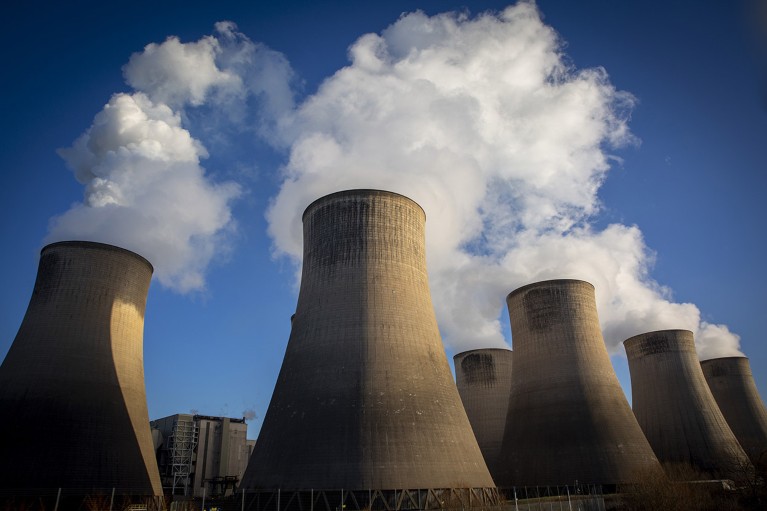
Smoke and steam bellows from the chimneys and cooling towers of Ratcliffe-on-Soar coal fired power station in England.
Taxes were particularly effective at reducing emissions associated with electricity generation in high-income countries.Credit: Andrew Aitchison/In pictures via Getty

“Researchers used machine learning to analyse roughly 1,500 climate policies and identify those that have dramatically reduced carbon emissions. Their study, published in Science today, found that policies that combine several tools are more effective in slashing emissions than are stand-alone measures1.

“The analysis identified 63 interventions in 35 countries that led to significant reductions in emissions, cutting them by 19% on average. Most reductions were linked to two or more policies. Together, the 63 policies cut emissions by between 0.6 and 1.8 gigatonnes (Gt) of CO2 equivalent.What’s the best way to tackle climate change? An ‘evidence bank’ could help scientists find answers

“Using the right mix of policies is more important than using a lot of policies, says Annika Stechemesser, a co-author and researcher at the Potsdam Institute for Climate Impact Research in Germany. For example, the UK’s phasing out of coal-fired power stations worked because it was used in tandem with pricing mechanisms, such as a minimum carbon price, while in Norway, banning combustion engine cars was most effective when combined with a price incentive that made electric cars cheaper.

“To my knowledge, it is a first-of-its-kind study providing such a global evaluation,” says Jan Minx, an environmental economist with the Mercator Research Institute on Global Commons and Climate Change in Berlin.

Road to reductions

As part of the analysis, Stechemesser and her colleagues used a database of 1,500 climate policies implemented between 1998 and 2022 in 41 countries, including the top three greenhouse gas emitters globally: China, the United States and India. The policies fell into 48 categories, ranging from emission trading schemes to fossil-fuel subsidy reforms.

“Previous evaluations have typically concentrated on a narrow set of prominent policies in selected countries, overlooking the hundreds of other measures,” Stechemesser says.

“The authors combined machine learning with a statistical analytical approach to identify large emission reductions in four high-emitting sectors — buildings, electricity, industry and transport. They compared the results with policies in the database to assess which policies and policy combinations led to the biggest emission drops.

“This is a rather clever method,” says Zheng Saina, who has analysed global climate policies at Southeast University in Nanjing, China. The conventional way would have been to review the large number of policies and select the important ones, but that approach is subjective and cumbersome, she adds. “The authors instead used machine learning to detect major emissions changes. It is more objective.”

Right mix

The results showed that certain policy combinations worked better in specific sectors and economies. In terms of reducing emissions associated with electricity generation, for instance, pricing interventions such as energy taxes were particularly effective in high-income countries, but less so in lower-and-middle income countries.

In the building sector, policy mixes that included phased out and banned emissions-generating activities more than doubled the reductions resulting from implementing those policies individually.

“Taxation was the only policy that achieved nearly equal or larger emission reductions as a stand-alone policy, as opposed to a policy mix, in all four sectors.

“Minx says the study’s AI-enhanced approach allowed the researchers, for the first time, to evaluate the effectiveness of a large number of climate policies from a global set of emission inventories covering different countries and sectors.

“For other researchers, the paper is alarming. “This study provides a warning to countries around the world that their climate policies have had very limited effects so far,” says Xu Chi, an ecologist at Nanjing University. “Existing polices will need to be re-evaluated, and changes will need to be made,” Xu adds.

“The world’s annual emissions are projected to be 15 Gt of CO2 equivalents higher by 2030 than would be required to keep global warming to less than 2 °C above pre-industrial levels, according to the United Nations.

” doi: https://doi.org/10.1038/d41586-024-02717-7

“References

  1. Stechemesser, A. et al. Science 385, 884–891 (2024).Article Google Scholar 

Download references

Reprints and permissions

“Latest on:

Climate changeEnergyPolicyExtreme heat is a huge killer — these local approaches can keep people safeNews Light bulbs have energy ratings — so why can’t AI chatbots?Comment How ‘green’ electricity from wood harms the planet — and peopleNews Feature  “

Thank you for your courteous, interested, interpersonally-engaged Rabbi Martin Buber-dcd style I & Thou attention.

 ٱلْحَمْدُ لِلَّٰهِ

Jonno One

Australia

The Graham Bonnet version

Muppets to the Left of me\\ Numpties to the Right

The phenomenology of the new neurolinguistics makes abundantly and powerfully clear that the socio-cultural and the psychosomatic are body-mind belief systems in the complete control of the well healthy person per the vibrant instantaneously co-operational sympathetic and parasympathetic nervous systems. In short the psychological is the socio-cultural and the raison d’etre (the reason for being or being alive) and multifarious raisons d’etat (the individual adult, couple, household, neighborhood, geo-community, region OR nation motifs and causes we all air and display) are psychological – equally and indivisibly the outcomes of socialisation, acculturation, mores, beliefs, tropes, memes, aphorisms, slogans, prayers, wishes, aspirations and ‘upbringing.’

Plato’s Race-memory, environs and genetic predisposition form an authentic mental trinity (or ‘triad’) in contrast to the sacramental or supposed (classical monist AND dualist) metaphysical.

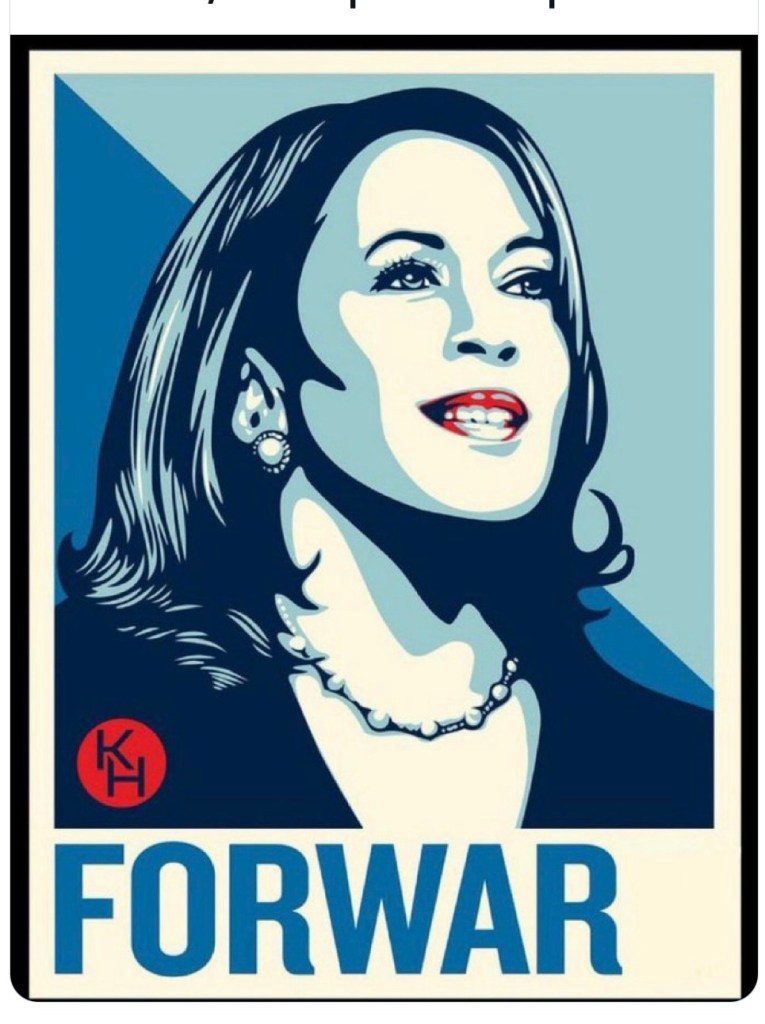
The person depicted above’s name is pronounced Kah-mahla, with equal accent or emphasis on the leading and trailing syllables -as indicated by the – conjunctor or classical hyphen above- and used in contemporary Greek speech – there can be no snappy if not terse or grunty or perhaps nasal emphasis on the first syllable and the use of the notorious Mary-Anne Fahey’s – not herself but her The Comedy Company character of 1989 Kylie Mole’s – Rising-debbie is frowned upon or at least frightens old ladies and gentlemen

(1) By way of a critical wierdshow corporate lawyers’ preamble go ‘here..’

“Previously, the site was hosted on the servers of Bomis, a company mostly owned by Jimmy Wales. With the announcement of the Wikimedia Foundation on June 20, 2003, the ownership of all domain names was transferred to the Foundation. The site is run by the community of Wikipedians guided by the five pillars.

“Wikipedia is a non-commercial website run by the Wikimedia Foundation, a 501(c)(3) non-profit organization based in San Francisco.

“Who owns Wikipedia?

“Wikipedia’s tech framework is supported by the Wikimedia Foundation, which also supports Wikipedia’s sister projects, including Wiktionary, Wikibooks, and others, and owns all of their domain names.

“Who governs Wikipedia?

“The Wikimedia Foundation is controlled by its Board of Trustees, which is required according to its Bylaws to have several members chosen from the Wikimedia community. The Board and Wikimedia Foundation staff do not usually take a role in editorial issues, and projects are self-governing and consensus-driven.

“Founded by Jimmy Wales and Larry Sanger on January 15, 2001, Wikipedia has been hosted since 2003 by the Wikimedia Foundation, an American nonprofit organization funded mainly by donations from readers. Initially only available in English, editions of Wikipedia in more than 300 other languages have been developed.

“The text contained in Wikipedia is copyrighted (automatically, under the Berne Convention) by Wikipedia contributors and licensed to the public under the GNU Free Documentation License (GFDL). The full text of this license is at Wikipedia:Text of the GNU Free Documentation License.”

What are the Four Trauma Responses Fight, flight, freeze, and fawn are a broader collection of natural bodily reactions to stressful, frightening, or dangerous events. This sympathetic nervous system response dates back to our ancestors coming face-to-face with dangerous animals. Jun 24, 2024

(2) For the hard and hurty for mental 11 year-olds facts, go ‘here..’

I, John Blundell, independent scholar and the man who is bringing to a dead end the notional Five hundred +15 Year \\ Five Hundred Fifteen year Romance Era and equally, necessarily and comprehensively ALL patronising and ‘matronising faux feminist’ micro-behavioural Raison-d’etat Warrior-prince Explorer-scientist depersonalising sexualising psychiatric Object-relations anodyne conversational patter3 passed off as intelligent human discourse since the Church pitted the pietistic1 sacramental against Dante Alighieri’s2 vernacular pronounce the Nineteenth-century neoclassical academic Fight, flight, freeze, and fawn ‘dead in the roiling global heating water’ and demand the immediate retirement of all peddlers-for-business-profit of evolutionary biology against the James Lovelock thesis Gaia (originally published in 1979, reissued in 2000 with a new preface, and reissued again in 2016 with a second preface as part of the Oxford Landmark Science series blah-didly-bitly-blah-diddly-blah-bla).

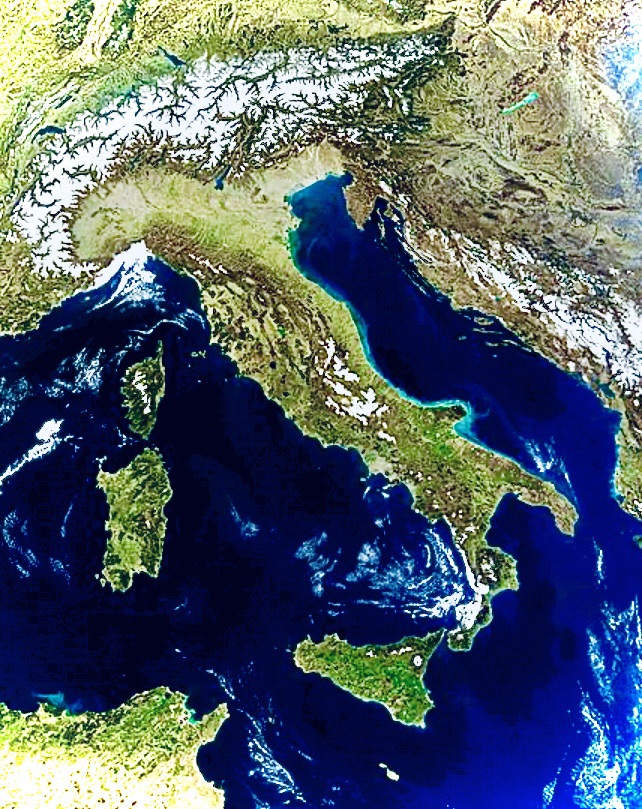
The Italian Peninsula

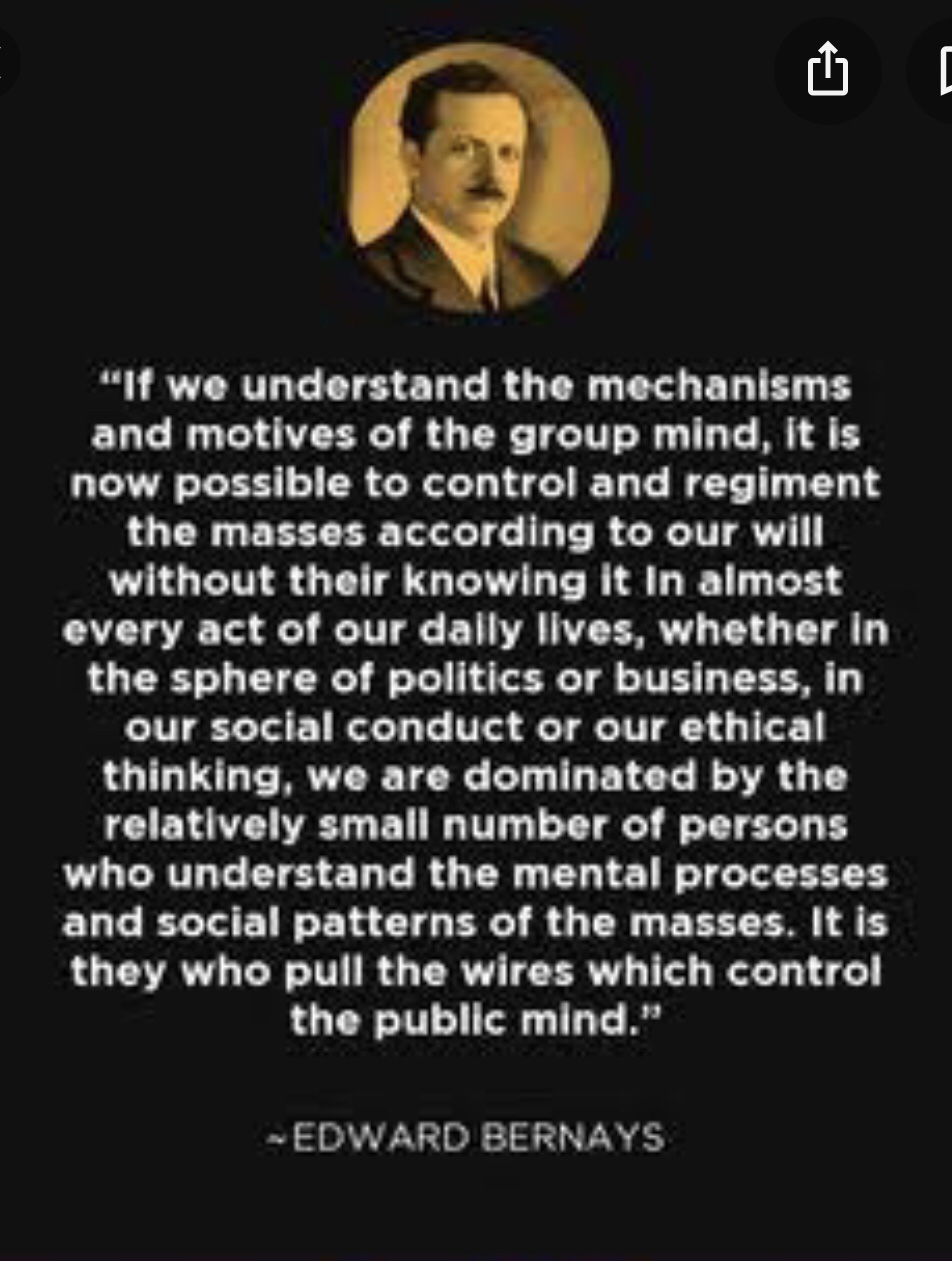
– Elegantly transition your heads team to Fight Feed Fuck Freeze Flee. Forget the FFF Flee Flummox read-out on greeneconomyact on @X I put out say three months ago. I am overjoyed if not triumphant to directly ideationally connect the animal, though mammalian animal in particular5 and human at moments of terror for some (ALL rape victims for example) as the individual’s (in new micro- -meso- -macro economic theory Centre Circle One’s of 9’s under a weather-systems smashed, roiling, now literally deoxygenating and sulfurising sky C10) Freudian parapraxes moments, mental crossovers – naming synonym as antonym, misnaming in general, malicious-aforethought hyperbole and dumbed-down or ‘de-skilled’ essentially diseducated “Bullshit-baffles-the-brain” SCIENTIFIC False-equivalence – the individial human Edward Bernays-esque Manhattan Rand, Greenspan and Branden (pop psychology hack)1960s polemical public relations human cultural mental ‘catastrophe’ – meditative-state, short-term recall failure, clinical shock, trance.. “being paralysed by fear..” Alzheimers,’ loss of brain-sympathetic executive (expressive) responses, dementia and catatonia..

‘Freeze,’ billions of us said, muttered or thought, repeatedly, habitually, unselfconsciouisly, reflexively like we were burping, poop-ing or gaily [\ not] kicking the “word” down some road, its dust invisibly suffused with depleted uranium we couldn’t see, hear, taste, smell, touch or come-on-down and put on a show about besides the FBI, CIA, Joe Rogan, Australian politician Dan Tehan, Marine le Pen, the Vatican Treasury office and the editor of Readers Digest would be onto us in a ‘flash’ if we so much as opened our mouths about the Matter.

Kerlahnck that’s me done for this morning.. and the next day.

..except my virtual greetings and salutations to all who want to expunge malfeasant fake science from their blessed households, neighborhoods and geographical communities around the world

..and the people of Baghdad

We sure know it’s been hellish hot for many weeks

كيف حالك؟

BLUNDELL

21,2 Aug 2024


3 famously, powerfully resoundingly condemned by Thunberg as Blah 28/9/20213A

1 fanciful-fatuous-fictive in the letter (or de jure qua demonstrable legal intent) and judgmental, condescending, mentally-calculated to cause harm to another or others & interpersonally violating in spirit

2Italian Peninsula regional story-teller/ fabulist poet late 13th C to 14/9/1321

3A Fascinatingly enough indeed the date of the fourth “anniversary” of what socially metastastasised into a now evidently permanent ‘rolling’ entropic Australian political class & ‘cognoscenti’ “Seniors-moment” – the3AA diagnostic and indeed prognostic certainly pro Gnostic psychological regression to RG Menzies era Reverse Class-warfare – psychological “downward” envy pitted manfully against “Pearl-clutching” or “Bed-wetting” – and some phenomenon the “hard core” ideological activists among the “crackers” public menaces call Being-awake(?). I think therefore I’ve probably made a Dog’s-breakfast of these Looney-tunes’ tightly-argued if not epistemologically fraught principal premises https://aje.io/5n3kq damn

3AA Grammatic definite object as dialecticised with the indefinite object culturally emergent in southern Europe particularly c’est/ say after Athenian city-state at the time of ‘heroic’ comedy acts Play-dough, Sock-crates & Harris Tottle (?)

4 “The Freudian slip is named after Sigmund Freud, who, in his 1901 book The Psychopathology of Everyday Life, described and analyzed a large number of seemingly trivial, even bizarre, or nonsensical errors and slips, most notably the Signorelli parapraxis.”

5 In a dementing world where hundreds of thousands of people are ‘earning’ the equivalent of $100k per annum (triple the lowest liveable income in Australian contemporary urban and suburban society including large regional centres, those ‘fed’ by huge supermarket chains) by & large children’s heads are pumped full of paleo-biology and all young people and adults 20 to110 know ten times as much about the reptilian brain – that human culturally-dominant foment of immediate gratification of wants and lusts, for example nowadays on display as random knife attacks on groups which idiots in public relations, security agencies and parliaments attribute to what they call terrorism and fiercely assert & aver have no connection with mental illness – while their opponents babble about empathy with the “neuro-divergent” as fundamental to a supposedly ideologically sound shared vision of lberal democratic society (for affluent white people like themselves, those with feet-on-ground & eyes not on screens wonder) – in the 21st century that is so plainly the psycho-social and diseducational precursor of ALL Autism-spectrum and ‘Attention Deficit Disorder’ (pharmaceutical corporation 45 year ‘Ritalin’ bonanza) neurocognitive (50% of causation) disorders – as about their own.

You Know I Believe and How

People of voting age cry out for representation in councils and parliaments and for regional through national leadership by government.

So they get together, do social activities and raise money – both of which pursuits are hugely aided by taxation exemption, concession, deduction and direct public (ex taxation revenues, largely overseas ‘growth-fund’ exports investment profits and immigrant, student or affluent tourist spending) subsidies.. a tartly named Activity Trap (the title of a short paper or magazine article by a business “man-age-meant” guy, a pom called I think George Robertson from my social psychology & social work studies days (the 1970s) i cldnt successfully search unsurprisingly enough because it was critical operant mature adult thinking discourse or peroration of the sort every pavlovian ‘Hit or Give’ ghoul in the billionaires’ e-comms de-skill Cabal hates and simply censors out of his or her or indeed – classically in grammatically off though it may be – their, increasingly ‘putrefying’ product in really and truly an apocalyptic runaround for innocent kids, working people and vain neurocognitively impaired old men..

Greens SA v-mail – 14 August, 2024

view in browser

Hi JohnWhat’s on in August?
What’s on in September?
Notices

Sarah Hanson-Young Campaign Kickoff – with Adam Bandt

Tuesday, September 3, 2024, 6:00 PM to 8:00 PM at Chateau Apollo, 74 Frome St, Adelaide

Join us as we kick off the Greens SA campaign to re-elect Sarah Hanson-Young to the Senate and win Sturt!

Greens Leader Adam Bandt will be heading to town, straight from his press club address.

So grab a friend, get your tickets, enjoy a snack from the platters, and hear from Sarah and Adam about the plan for re-electing Sarah!MORE INFO

What’s On in August?

The Greens | Branch | Action Group | Community

TODAY: Volunteer Welcome Night

Wednesday, August 14, 2024, 5:30 PM to 7:30 PM at The Greens SA State Office, 7/291 Angas Street, Adelaide

Hear from Greens organisers and volunteers about how a strong people powered campaign can win elections and how you can be a part of it!

Learn about the different ways you can get involved. From letterboxing to phone banking, doorknocking and market stalls. There is something for everyone.

Vegan dinner provided. REGISTER

Stirling Knock-off drinks with Robert Simms MLC

Thursday, August 15, 2024, 5:00 PM to 7:00 PM at Miss Perez Kitchen & Bar, 2 Druid Avenue, Stirling

Join Greens MLC, Robert Simms for a drink and casual conversation on the big issues impacting our day-to-day lives: cost of living and the housing crisis, rising inequality, the climate crisis, the ramping crisis, and more! Drinks will be available for purchase at the bar. MORE INFO

Food waste lecture by Dr Stephen Lapidge CEO of End Food Waste Australia

Thursday, August 15, 2024, 5:00 PM to 7:00 PM at Hetzel Lecture Theatre, Institute Building, State Library of SA, North Terrace, Adelaide

If food waste was a country it would be ranked the third highest emitter of greenhouse gases after China and the USA. EFWA is committed to creating a more productive, sustainable, and resilient Australian food system by ending food waste and food insecurity.
Cost $10MORE INFO

Doorknock Prep Working Bee

Friday, August 16, 2024, 11:00 AM to 2:00 PM at The Greens SA State Office, 7/291 Angas Street, Adelaide

Help prepare the doorknocking lists for the weekend sessions.

Drop in to state office during the day on Friday to prep the doorknocking lists.

A lot of work has to be done to ensure our events are successful and our campaigns productive so come along and share the load. REGISTER

Silent Vigil for Palestine

Friday, August 16, 2024, from 06:30 PM at The Malls Balls, Rundle Mall, Adelaide

Join Health Workers for Palestine in memory of, and solidarity with our colleagues in Gaza and the West Bank. Wear your scrubs/uniform if you can. Non HCW folk, families and children are all welcome.MORE INFO

Sturt – Renters’ Rights Doorknock with Rob 

Saturday, August 17, 2024, 10:00 AM to 1:00 PM at Rose Reserve, 1A Kingsley Avenue, Glenunga

Did you know almost a third of South Australians are renters? Rents are increasing 5x faster than wages and both major parties refuse to support a rent freeze or rent caps.

Join Rob Simms for a doorknock and connect with renters in Sturt.REGISTER

Adelaide & Sturt All-In Doorknock

Saturday, August 17, 2024, 2:00 PM to 5:00 PM at Howard Florey Reserve, Campbell Road, Parkside

Adelaide and Sturt are joining forces once more for an ALL IN doorknock on the border of the two electorates.

We will hit the streets to talk to the good people of Parkside and Fullarton before heading to the Parkside Hotel for a social catch up and celebration.REGISTER

Anti Nuclear Power SA – Campaign meeting 

Saturday, August 17, 2024, 2:00 PM to 4:00 PM at The Joinery, 111 Franklin St, Adelaide

Join Anti Nuclear campaigners in SA to talk about and plan how to stop the Nuclear power plant proposals in SA and nationwide. 

If you missed the previous online briefing you can watch it here.MORE INFO

🦊🐿️🦔🐁🐀🐇🐰🐩🐕🦮🐈‍⬛🐈🐠🐟

You have received this ‘Billionaire 🐒🐒🐒🐒🐒🐒s Olivetti Research Group’ – at Noam Chomsky’s (but not the startling funtionalist University of California Berkeley’s Erving Goffman’s) old place of sitting-in-your-office typing shit and also talking a lot the Massachusetts Institute of Technology (known to old rich people as the alma mater) compendious big-data frogshit newsletter because we’ve got your profile and your consumer transactions totally typed and thought you’d like to read ‘something’ divergent, macro-scaled and opposite not apposite to the endless falling-to-vortical-infinity and it’s dark down there in that hole – goodness me children now y’all look the other way – of the lunatic neoclassical anodyne Right-thinking (traditional, original and at least 10k year-old human societies’ Right-side value, belief and cultural praxis that is exactly to say their law) academic cultural hegemons of late nineteenth century England (particularly the northern industrial indigenous and exogenous slave economies of one of my own four great-grandfathers) and those who sucked to and fiscally nurtured it among the ‘Ivy League’ colonial aristocrats of the East Coast USA including of course the slavers of the USA South and the Caribbean – right down 400.5 decades (officially) of retrograde pre-civil society brutalisation ‘reducing’ employee wages and maximising not optimising business profit without regard to any law, to a plainly ecocidal and tberefore within another decade genocidal result or end, or as we address the orgiastically ignorant Christian Old Testament fundamentalist halfwits my scholarly liberal socialist educated grandfather ACL Sanders so deplored and fought exercising political power absent of scrutiny by any court or legislative or administrative authority – or horrific man-made End of Times end as in the officially ‘expanded’ Northern Territory Top End economic circle 6 global region of Australia this day.

That “endless falling-to-vortical-infinity:” tell me the above image is not flat, dumb, two-dimensional and in terms of the Paris 1968 upper middle-income liesure-time chatter (all day & half the night, right) not Art

Sturt & Adelaide Social Drinks

Saturday, August 17, 2024, 5:00 PM to 6:30 PM at Parkside Hotel, 142 Glen Osmond Road, Parkside

After our afternoon doorknocking session the Adelaide & Sturt volunteers will head to the Parkside Hotel for a social catch up.REGISTER

Sturt Doorknock in Campbelltown

Sunday, August 18, 2024, 9:30 AM to 12:30 PM at Charlesworth Park, 6/16 Park Street, Campbelltown

Great-grandchildren

Join the Sturt Greens team as we chat with voters and listen to what issues matter to them.

At the start of the session you’ll meet your team and have a quick training before heading out to talk to voters. No experience is necessary – if you’re new, we can pair you up with an experienced doorknocker.REGISTER

Greens at Save the Cranker Rally – Sarah & Rob both speaking

Sunday, August 18, 2024, 1:00 PM to 4:00 PM at Tarntanyangga/Victoria Square, Adelaide

The grassroots campaign to save the “Cranker” – Crown & Anchor Hotel continues with a massive rally followed by live music on two stages at Adelaide’s most loved pub. Join Greens Senator Sarah Hanson-Young and Greens MLC Robert Simms to show your support for saving this iconic Adelaide place.

It is not just a heritage listed façade. It is not just a historical pub. It is not just a live music venue. It is alive, and we cannot lose it.REGISTER

Campaign Working Bee

Tuesday, August 20, 2024, 5:30 PM to 7:30 PM at The Greens SA State Office, 7/291 Angas Street, Adelaide

Drop in to state office for an evening of volunteer recruitment, data entry and all the behind the scenes tasks that make our campaigns run. 

Please bring a laptop and a phone, or let us know if you need them to be provided. REGISTER

Recruitment Systems Training

Wednesday, August 21, 2024, 5:30 PM to 7:30 PM at The Greens SA State Office, 7/291 Angas Street, Adelaide

Learn how to use ListManager, our platform for creating calling lists and recruiting volunteers. This will be a crucial tool for your campaign team. The training will cover how to use the systems, log your calls and contact notes, how to create a phone calling list and some best practice tips and tricks when on the phone!REGISTER

Sturt Market Stall at Fullarton

Saturday, August 24, 2024, 8:15 AM to 2:00 PM at Fullarton Market, Fullarton Road

Join the Sturt Greens team at the Fullarton Market to chat to locals about Greens policies and campaigns.

You can help out for the whole morning, or just pop by for a quick stint. Any and all help is appreciated! REGISTER

Sturt Weekend Doorknocks

Saturday, August 24 & Sunday, August 25, 2024

Join the Sturt Greens team as we chat with voters and listen to what issues matter to them.

Saturday, August 24, 10am-1pm:Tusmore

Saturday, August 24, 2pm-5pm:Hazelwood Park

Sunday, August 25, 10am-1pm:Toorak Gardens

Sunday, August 25, 2pm-5pm:Heathpool

At the start of the session you’ll meet your team and have a quick training before heading out to talk to voters. No experience is necessary – if you’re new, we can pair you up with an experienced doorknocker.

SA Young Greens – NT Election Watch Party

Saturday, August 24, 2024, from 6:00 PM at State Office, 7/291 Angas Street, Adelaide

Join the SA Young Greens to watch the NT election results unfold at State Office!

For more info, please email SAYG Co-Convenors on young.greens.convenor@sa.greens.org.au

Australia West Papua Association SA Quiz Night 

Saturday, August 24, 2024, 6:30 PM to 10:00 PM at Unley Community Centre, 18 Arthur Street, Unley

The Australia West Papua Association SA invites you to join our Quiz Night. Support the cause for the respect and empowerment of West Papuans’ human rights!

Doors open 6.30 for 7pm start. BYO food and drink. Admission $20 waged / $10 concession. Tables of up to 8-10 are welcome, as are individuals or small groups. Please bring some gold coins for games between the main quiz rounds.

Book with Dave on 0408 345 593 or dave-arkins@bigpond.com.MORE INFO

Adelaide Doorknock in Gilberton

Sunday, August 25, 2024, 2:00 PM to 4:30 PM at Park 8, Adelaide Parklands, Melbourne Street/Princes Hwy, Adelaide

Join the Adelaide Greens team as we chat with voters and listen to what issues matter to them.

At the start of the session you’ll meet your team and have a quick training before heading out to talk to voters. No experience is necessary – if you’re new, we can pair you up with an experienced doorknocker.REGISTER

Sturt Week of Action 

Monday, August 26 to Sunday, September 1, 2024

If you’ve been meaning to get involved in the campaign to win Sturt, then this is the week to do it!

Monday 26th August to Sunday 1st September: Sturt Letterboxing Blitz – help us deliver leaflets in your own time throughout this whole week.

Tuesday 27th August, 5.30-7.30pm: Campaign Working Bee – drop in to State Office to help out with volunteer recruitment, data entry, and all the behind the scenes tasks that make our campaigns run.

Calling all experienced doorknockers for our midweek POWER DOORKNOCKS:

Wednesday 28th August, 4-6pm: Power Doorknock in Rose Park

Thursday 29th August, 4-6pm: Power Doorknock in Glen Osmond

Join us for one or more of our weekend doorknocks as we chat with voters and find out about the issues they care about. No experience necessary, training will be provided:

Saturday 31st August, 10am-1pm: Linden Park Doorknock

Saturday 31st August, 2pm-5pm: Magill Doorknock

Sunday 1st September, 10am-1pm: Hillcrest Doorknock

Sunday 1st September, 2pm-5pm: Burnside Doorknock

What’s On in September?

The Greens | Branch | Action Group | Community

Greens at Walk for Respect

Saturday, September 14, 2024, 9:00 AM to 12:00 PM at Tarntanyangga/Victoria Square, Adelaide

Walk for Respect – A peaceful, non-confrontational walk to raise awareness of the key signs of Domestic Violence & Coercive Control against women, men children!MORE INFO

AFOPA Quiz Night 2024

Saturday, September 14, 2024, 06:30 PM to 10:00 PM at Goodwood Community Centre, 32 Rosa Street, Goodwood

Young AFOPA invites you our annual night of fun and friendly competition, with all proceeds to support the work of AFOPA. BYO nibbles or supper. Tea, coffee, drinks available. Great prizes to be won!MORE INFO

Heysen Doorknock in Aldgate

Saturday, September 21, 2024, 10:00 AM to 1:00 PM opposite FRED Eatery, 220 Mount Barker Road, Aldgate

Get involved in the campaign to win Heysen! We’re knocking on doors in Aldgate to hear from our community about the issues they care about.

At the start of the session you’ll meet your team and have a quick training before heading out to talk to voters. No experience is necessary – if you’re new, we can pair you up with an experienced doorknocker.REGISTER

Boothby / Kingston Quiz Night

Saturday, September 21, 2024, 7:00 PM to 9:30 PM at Cove Civic Centre, 1 Ragamuffin Drive, Hallett Cove

Six fun rounds including political, local, environmental, music/movies, geography/history.

Tables of 8 – or come as a single, couple or other combination and we’ll match you to a table.REGISTER

The Koalas – A movie about survival 

Sunday, September 29, 2024, 4:00 PM to 7:00 PM at Palace Nova East End Cinema, 3 Cinema Place, Adelaide

Join us for the ADELAIDE PREMIERE THE KOALAS – a movie about survival that tells stories of resilience of this iconic species in the face of threatened extinction in the wild.

Following the screening will be a panel discussion with Greens Senator for South Australia Sarah Hanson-Young.

“Action comes out of brilliant movies like The Koalas” – Bob Brown

“You’ll be charmed. You’ll be dismayed. And then i bet you’ll be as angry as hell” – Tim Winton AOMORE INFO

Big Ride for Palestine SA – bike jerseys

The Big Ride for Palestine SA jerseys are ready!

The Jerseys have been professionally designed and feature the logos of key sponsors. For a limited time, there is an introductory price reduction for the first 50 sold. Get in early, buy a jersey, and fly the flag of support for Palestinian resistance on the streets of Adelaide.

Join us on our regular rides and also for the major AFOPA Run Walk and Ride for Palestine at Glenelg to be held on Sunday 13th October. ORDER ONLINE

ANMF Union Members Open Letter for Gaza

To all ANMF union members, retired members, nursing/midwifery students- let’s tell our union to speak up for human rights and healthcare in Gaza.

Please support us and share the link with nurses, midwives and personal care assistants. The open letter is national.

Civil society and businesses that want to stand with us and endorse the letter, as The Greens SA have done, please email anmfsamembers4peace@gmail.com.SIGN THE LETTER

Letterbox Robert Simms’ Adelaide Hills Community Survey

Can you help us deliver our Community Survey flyer into Adelaide Hills letterboxes?

We’re looking for letterboxers for Aldgate, Bridgewater, Crafers, Crafers West, Hahndorf, Heathfield, Mount George, Mylor, Norton Summit, Piccadilly, Stirling, Summertown, Upper Sturt, and Uraidla.

Email michael.donato@parliament.sa.gov.au to lend a hand.

Old Greens Tshirts

Do you have any old Greens (or just green) tshirts lying around that are really no longer fit to be worn? Here is the perfect recycling pathway for them!

Jacqui Hunter of Hunter Gatherings is organising a Nature Festival event celebrating the Adelaide Parklands, and is collecting old green tshirts to be cut up and transformed into scarves. If you have something suitable, they can be dropped to the Adelaide Sustainability Centre at The Joinery (111 Franklin Street, Adelaide) or to The Greens SA State Office (7/291 Angas Street, Adelaide) by Friday 6th September.

For more info, please contact Jacqui on huntergatherings1@gmail.com.

Greens SA Fundraising Working Group

Interested in helping to raise campaign funds? Please contact Peta-Anne Louth on hello@peta-anne.com to find out more about the Fundraising Working Group.

DONATE TO THE HEYSEN CAMPAIGN

Only 991 new votes are needed to win Heysen. We invite you to make a regular, or a one-off donation to the Heysen 2026 election campaign. All donations above $2.00 are tax-deductible. We thank you for your generosity.DONATE NOW

Join the Heysen Campaign Team Chat

Mayo Branch is campaigning for victory in the state seat of Heysen in 2026. We need just 991 new votes to win! Join the team and stay up to date with all the campaign developments and opportunities in our secure, end-to-end encrypted group chat.JOIN CHAT

Sign up to Adelaide Hills Councillor Melanie Selwood’s Newsletter

Want to stay updated on initiatives and community projects in the Adelaide Hills?
Sign up to Greens member, Councillor Melanie Selwood’s email newsletter for issues, events, and green wins in the Hills. Staying informed will help us win the seat of Heysen at the next state election.SIGN UP

Join the Queer Greens SA

Join the Queer Greens SA to find out about local actions and planning sessions related to LGBTIQA+ issues, and to get involved with social activities.

Sign up below, or email queer.greens@sa.greens.org.au for more details.SIGN UP

Greens SA Housing & Homelessness Action Group

South Australia is in the middle of a full-blown housing crisis. Join the Greens SA Housing & Homelessness Action Group to find out more about what we can do to take action in local communities.

Sign up below, or email housingaction@sa.greens.org.au for more details.SIGN UP

SA Young Greens

If you are under 30, come along to our monthly meeting on the second Sunday of every month, newcomers welcome! Link below to check out our socials for more info on the next meeting and other activities.

For more information, please email Young Greens Co-Convenors Declan and Lily on young.greens.convenor@sa.greens.org.auSOCIAL LINKS

Borrow our Home Energy Toolkit

We now have a Home Energy Toolkit available to hire from the state office. Please email saoffice@sa.greens.org.au to borrow (for a maximum of 1 week).

Click below to see what’s included in the toolkit.MORE INFOAdd your Event or Notice to the V-mail

Facebook | Twitter | Join the party | Contact Us| Donate

The Australian Greens acknowledge the proud traditional custodians of the land upon which we’ve sent this email from, and where we live and work. We pay respects to the Elders, past, present and future, across the many Nations, for they hold the memories, the traditions, the culture and the hopes of Aboriginal and Torres Strait Islander peoples across Australia. Their ancestral ties to country have never been extinguished, and sovereignty never ceded.

This message has been sent to Greens SA volunteers from The Greens SA State Office

V-mail is the formal notification of The Greens SA party and other events and is emailed weekly to volunteers.

Authorised by A Wheaton, The Greens, 7/291 Angas Street, Adelaide, SA

This email was sent to blundelljohn37@gmail.com
If your contact details have changed, please take a moment to update your details.

Why did I get this? · Unsubscribe from this list · Opt-out from all our lists

🐴🦄🫎🐝🐦‍⬛🦆🐤🐔🐣🪱🦋🐞🦕🦖

I’d as a new-century political theorist & public educator eradicate Carrot & stick/ Hit or Give barbarism – the Dialectics of the Damned Green Economist 1994

The following song excerpt – 4 paragraphs ahead – and of course the title of this wistful document about how we really make successful liberal democracies out of bourgeois consumer society pluralism when the lower middle class on five continentas is being hollowed out, devoured, extinguished no-bones-spat-out by the billionaire’ mil-ind-sci-financier cabal – is not for my part anything much to do with the inspiration of Ray Charles, boy-girl stories or “other lovers (goodness-me),”Harrison dcd 2002’s first wife PH, marijuana, cocaine, Crystal(🥳) methamphetamine, the Maharishi Mahesh Yogi, 1969, Ritalin, MDMA mescaline, ‘Bipolar,’ “affective” disorder, other depressive mental illness originating in overstimulation shock or psychological/ physiological trauma, the scores of recording ‘industry’ covers or the millions of utterly useless human vanity-project words and tributes a lá the disappointed preacher Ecclesiastes* some fools expect to zip & flash & whoosh up & down & about bits of quartz with teeny-weeny welds & circuits, pins, plugs & wires on them for decades, even hundreds of years for Christ’s sake, in huge sheds or factories, energy profligate, and within two or three years impossible to cool with fresh water because there’ll be entire cities that can no longer get enough of that stuff), in Semiconductor fabrication plants, email account-fleecing captive labour camps, gulags and USA prisons – is what i offer at this time as kind of cry of the common man or woman.

* Ἐκκλησιαστής, romanized: Ekklēsiastēs) is one of the Ketuvim (“Writings”) of the Hebrew Bible and part of the Wisdom literature of the ChristianOld Testament

‘You’re asking me will my love grow
I don’t know, I don’t know
You stick around, now it may show
I don’t know, I don’t know..’

So yes we need to talk about what works. That’s me done for today.

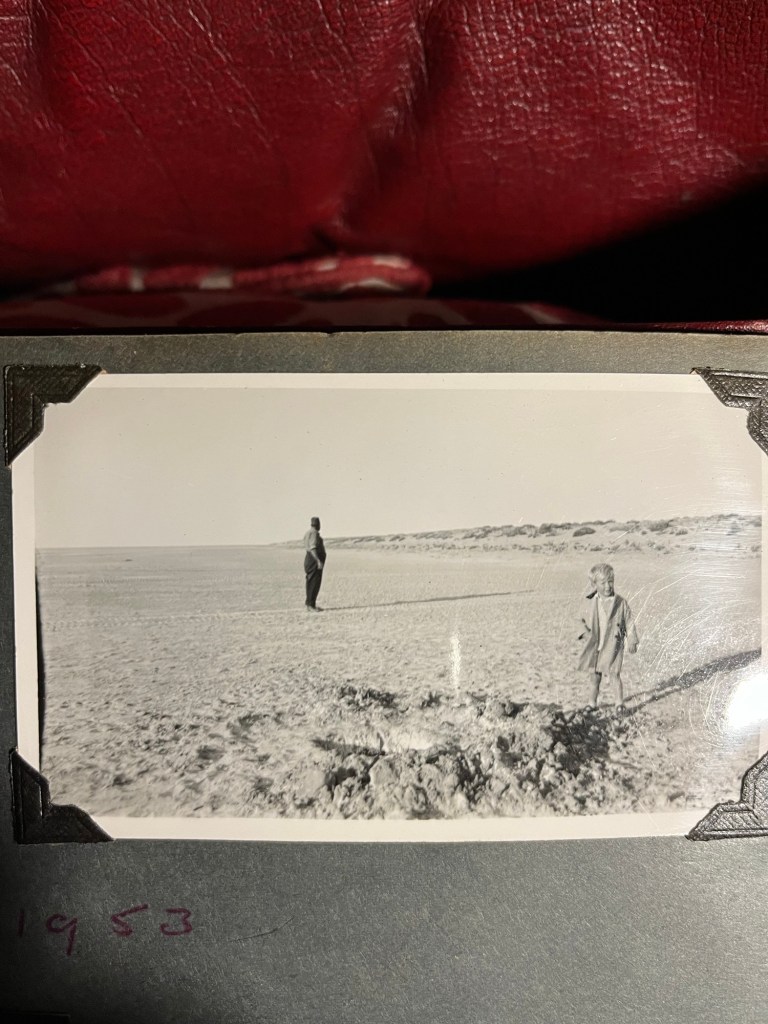
Lake Eyre South 1953: stick around: we’re all here to learn

🐥🦉🐉🐀🦡🦜🐿️🦢🐃🐈🐇🦮🦨🐁


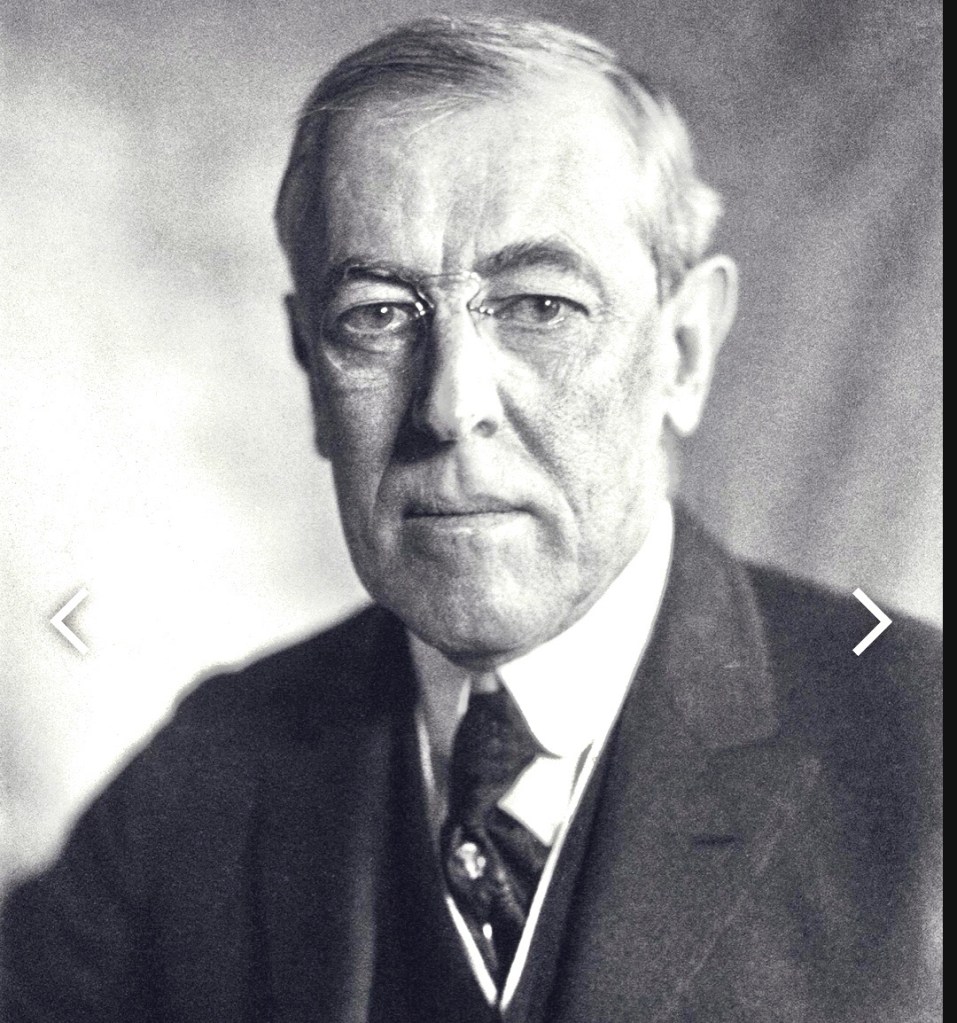
Political Science professor at Bryn Mawr College, a newly established women’s college in Bryn Mawr, Pennsylvania, then 12 years at @Princeton. Second Presbyterian Church elder.

John Blundell

Sth Australia🦘🌏🌍🌎🌐❌FF🔥

55 year McLuhanite Scholar

Post Socratic Logic

Neurolinguistics

Philosophy of Science

Economics

🐕‍🦺🐐🐎🦬🦏🦍🐊🦣🐪🐠🦐🦞🐬🐳

And John will maybe look up what a ‘fab’ is.

Complete edition Wed 7th Aug 2024
Lan Sakes Miss Kerri-anne it’s a 🍤

Chartbook 306 Nodes, rebar and private equity- How Intel, the weak link in the chip strategy of Bidenomics, is resorting to financial engineering to raise billions for fabs.

ADAM TOOZE

AUG 7

Amidst the market focus on AI, Nvidia and the fab 7, and the political cycle which is directing attention towards VP-picks and rallies, I worry that a big story of last week may get swept under the rug: the catastrophic news out of Intel. 

Last week Intel, announced 15,000 job cuts, and suspended a dividend that has been in place since 1992. As Bloomberg reported, Wall Street is “losing patience”. “Investors are pulling the kill switch.”

The stock has plunged to levels not seen in a decade. 

Why does this matter? 

Upgrade to paid

Not because the world is short of the kind of chips that intel is struggling to make. On the contrary, we are just slowly exiting a cyclical glut. If Intel does manage to establish itself as a chip designer and a significant maker of chips (fab operator) that will offer more choice to buyers. But this is not why Intel really matters. 

Why Intel matters is geopolitics and the new political economy of industrial policy. 

In a world of geoeconomics, decoupling, derisking and disentangling from China, Intel is claiming the role as a national champion. As Susannah Glickman explains in this excellent piece for Phenomenal World Intel has since the late 1960s been at heart of the state-business nexus that defines chip manufacturing and the political economy of high-tech everywhere around the world. 

In the last few years under the sign of the new industrial policy, Intel has attracted giant subsidies both from the US, via the CHIPS act, and in Germany. All told, the subsidies committed to Intel around the world, at least on paper, run to more than $20 billion, for one, private company, not in lguarantees, but in hard cash. 

Back in 2023 when the industrial policy hype was at its max, I was a sceptic. I did a bunch of TV and other interviews in Germany questioning the logic of Berlin’s public subsidy for Intel. What I was worried about was:

  • The staggering capital intensity of the industry. This is a sector where private companies will spend over $10 billion per quarter in capex. Source: Semiconductor IntelligenceIn an industry operating on this scale and at this pace, is the public balance sheet big enough to play? I know that sounds like a crazy question, but the CHIPS act allocates .. drumroll … $39 billion in subsidies for creating or expanding U.S.-based semiconductor fabs and an additional $11 billion in research and development. And the money takes many, many months to disburse. In the world of semiconductors that is the spending of one player for one year. For Germany, hobbled by the debt brake, this is very deep water to be playing in. 
  • The semiconductor industry, an ultra high-tech commodity sector with long lead times, is dominated by the vicious swings of a classic commodity cycle (think “hog cycle”). In 2023 policy-makers were harking back to the post-COVID chip shortage, whereas at that very moment we were heading into an industry wide downturn and glut. Again, the industry moves far faster than politics. Source: WSTS
  • Furthermore, industrial policy makes most sense at an early stage where it can hope to exercise something like a formative influence, or in industries with many players and plenty of opportunity for benchmarking and competition. The global semi-conductor industry, by contrast, is a vast oligopoly in which the winning and losing hands were already distributed. Taxpayer-funded industrial policy has virtually no chance to creatively reshape the industry. Anyone wanting to play the chip game on a substantial scale has to get in bed with the big players. And amongst those, intel is the big loser. 
  • Intel was once a world leader. It formed a combination with Microsoft and IBM in the 1980s which shaped the early stages of desktop IT. But in the 2000s it missed the boat on chips for cellphones. Then on the fab side it made fundamental missteps in manufacturing. And then it missed the boat on AI. So now it is playing catchup on all fronts. On chip design, as the Economist notes, Intel is miles behind:This year it expects to sell $500m of its Gaudi ai chips. Nvidia sells $20bn of its ai chips each quarter. What is more, success in the market for ai chips is about more than the chips themselves. Nvidia sells networking gear that ties together hundreds or thousands of its processors. It also has cuda, a software platform, which allows customers to fine-tune the chips. 

  • Finally, more superficially, Intel’s leadership are no doubt highly skilled engineers, but the current CEO is perhaps best described as “weird”. Back in 2022 in seeking to goad Congress into acting faster on the CHIPS act, he remarked about the EU: “This complex 27-member socialist union . . . is now ahead of the US by a solid six months.” Unless this was intended tongue in cheek, and that does not seem like Pat Gelsinger’s style, this is someone who does not understand that he does not understand the people he is dealing with. 

Amidst the hoopla of securing the Intel commitment to Germany, I though a fragile coalition in Berlin was underestimating the risks of getting into bed with this firm. I thought the same was probably true for Bidenomics too Washington, but Washington, at least potentially, has resources to play in the big leagues. Intel is an American company. Added to which, Intel was promising to build the “silicon heartland” in Ohio and, you know, when it came to the heartland there was no arguing with the Bidenomics people. 

Online in press releases from a few months back, Intel pitches a story of global expansion and its range of partners. 

In the US, we are expanding our existing operations in Arizona, New Mexico, and Oregon, and investing in two new leading-edge chip factories in Ohio. We have submitted all four of our major project proposals in Arizona, New Mexico, Ohio, and Oregon to the US Department of Commerce’s CHIPS Program Office. These projects are estimated to represent over $100 billion of US manufacturing and research investments over the next f ive years. In the EU and Israel, we have announced a series of investments spanning our existing operations in Ireland and Israel, as well as a planned investment of more than $33 billion in Germany to build a leading-edge wafer fabrication mega-site. We have also announced our plans to invest up to $4.6 billion in an assembly and test facility in Poland, and the start of high-volume manufacturing using Intel 4 technology and extreme ultraviolet (EUV) technology in Ireland. … Intel teams across the globe are installing new tools, delivering new clean rooms, and completing construction of new buildings. To give an idea of the sheer scale of operations, in 2023, about 145,000 tons of steel—roughly the weight of 20,743 African elephants—was used in our construction and expansion projects, Our construction teams also poured over 2 million cubic yards of concrete—enough to build the Empire State Building 32 times over. 

Source: Intel 

But, all this talk about factories and machinery and steel and concrete, cannot hide the fact that twelve months on from the German announcement and two years on from the CHIPS act, in terms of actually mass-producing ultra high-end chips that are competitive at the global level and able to generate profit, Intel is way behind its competitors and the gap will not close anytime soon.

CEO Gelsinger tells a story to analysts of building two world-class companies: the Fab side and the product-development side. The product designer will be able to choose not just intel production facilities, but fabs anywhere in the world. The fabs will make not just intel chips, but will be open for business from all comers, which makes them particularly attractive from a US strategy point of view. 

But as one Timothy Prickett Morganremarks, this may be a good patter but, “that is a lot calmer than the situation really is. This is going to be hard to watch over the next couple of years, and even harder to do.”. 

The results that caused the stock value to crash tell the story. 

Here ends the Chartbook item

Dubbya & Pope Discuss Fabs & the extraordinary inside-out man Colon Powell

BLUNDELL

I did set out to pull down a paragraph for that magnanimous pusillanimous awesome short essay + photo-essays Little🚀🧨🚀🧨🚀🧨🚀Man @X account – mine doesn’t get stuck up Concentric Economic ⭕️ 10 – Blundell 1995 Australia 🦘🌏 – GEA.

But several times a day industrious professional writers everywhere are irritated if not annoyed – some of us even mentally fit to ‘kill’ – about the time-wasting – as much 2 or 5 minutes an hour – overlaid, or to use a mechanical metaphor (hydraulics) fancy-arsed but data-jumble incident ridden monumentally useless ‘5G’ information ‘servo systems’ whose only known or ever demonstable purposes are to sell deskilled kids crap product and even more execrable deracinated – unrooted in lived experience or regional socio-economic-cultural or political transactions. So to end the long macro story for some micro WHAMMO the machine wouldn’t let me neatly excise a carefully selected say 220 Character paragraph easily so i copied the whole ‘shooting match’ and published it here AS A GREAT PROMO FOR THE AUTHENTIC HISTORIAN GUY❗️

John Blundell

Post Socratic Logic, Neurolinguistics, VG Childe’s 1940’s ‘household’, or oikonomia (Greek οἰκονομία), usually translated as MICRO ‘governance’ which he spelled OEkomenia I recall & Philosophy of Science

Ask Why We’ve Blown It All Away

Here’s the front page of the esteemed @LeonSimons8’s ‘X’ account

For a year now Mr Simons has courageously, indefatigably and in the face of commonly foolish complaint advanced the public facts about sulphide aerosols IN RELATION TO pre-apocalyptic heat forcings from the North Atlantic ocean.

Searching for some intelligent human speech or text on Gaia and the magnificent and inspirational NON rhetorician and non nonscience fraud James Lovelock deceased 2022 I basically find a rant about some ancient committee calling itself Scientists for Nuclear Energy and am left bereft with the 1970s private schoolboy assertion that the earth was not at all a multi-systems virtual or quasi living entity but a mega bigly bunch of politically correctly (not to frighten ailing folk, the neurocognitively-challenged rich people, deter overseas tourism or upset the billionaire cabal gentlemen) HYPOTHESISED electromechanical shitbox crying out as it were for boiling up in cauldrons, pickling, dessicating, placing in glass cases and supposedly – remember, young people, in your anthropoverse, literary, musical & generally artistic flair are the money (automatically regenerating – just like toxic sythetic chemicals free organic food production so-o-o good 4 plan it end peeple – ‘AI’ and Dalle 3 whizzo with vast galaxy-gulping stored electrical energy aka ‘data’ for example) Charging the People a Dollar & a Half Just to See ’em.y

👉🏽 Your keys to success in business, supply side economy AND household bliss

I also find the following per courtesia @Wikipedia..

CLAW hypothesis

The CLAW hypothesis proposes a negative feedback loop that operates between ocean ecosystemsand the Earth’s climate.[1] The hypothesis specifically proposes that particular phytoplankton that produce dimethyl sulfide are responsive to variations in climate forcing, and that these responses act to stabilise the temperature of the Earth’s atmosphere. The CLAW hypothesis was originally proposed by Robert Jay Charlson, James Lovelock, Meinrat Andreae and Stephen G. Warren, and takes its acronym from the first letter of their surnames.[2]

Anti-CLAW hypothesis

In his 2006 book The Revenge of Gaia, Lovelock proposed that instead of providing negative feedback in the climate system, the components of the CLAW hypothesis may act to create a positive feedback loop.[3]

Under future global warming, increasing temperature may stratify the world ocean, decreasing the supply of nutrients from the deep ocean to its productive euphotic zone. Consequently, phytoplankton activity will decline with a concomitant fall in the production of DMS. In a reverse of the CLAW hypothesis, this decline in DMS production will lead to a decrease in cloud condensation nuclei and a fall in cloud albedo. The consequence of this will be further climate warming which may lead to even less DMS production (and further climate warming). The figure to the right shows a summarising schematic diagram.

Evidence for the anti-CLAW hypothesis is constrained by similar uncertainties as those of the sulfur cycle feedback loop of the CLAW hypothesis.

However, researchers simulating future oceanic primary production have found evidence of declining production with increasing ocean stratification,[9][10] leaving open the possibility that such a mechanism may exist.

John Blundell

• Post Socratic expressly 2-5 set Quantum-relations Logic

• Fact-object-person-location-meaning-plan neurolinguistics/ accurate human communication & the new order in 25,000 universities

• Adelaide Hills of Sth Australia 4th August 2024

Gates-Musk-Bezos Shitshow is Literally Shutting Down Your World For You ?

So toughen up Flossy/ Fozzy Bear !

You will alway be able to rely on me and my C6 to C9 real economy publishing entities delivered free-of-charge daily and i dearly hope also participate actively in our work to s-m-a-s-h the mediaeval robber-barons and post Civil War USA carpetbaggers BUT YOU HAVE TO DO THE READING & TEACHING.. as i do.

NOT SURE what’s going down here? Feeling twitchy?? Yeah well cut the self-indulgence because it’s NOT about you and never was but is about clinically psychopathic plutocrats AND just hop along to the @X account @greeneconomyact formerly @wired_we

John Blundell

Neurolinguistics

Post Socratic Logic

21st Century Weather-systems Ecosystems Science

The Wresting of the Social Sciences in their entirety from Patriarchic Nutters & Genocidists

THURSDAY 11 July 2024

Far East Russia HK Melanesia West Pacific Time

Horse-trading Inflation Reduction Macroeconomic Theory Collapses

..a CHARTBOOK BORROW FOR OLIVETTI – BANGIN’ MONKEYS which is followed by the most action-oriented incisive critique of the collapsing Military Industrial Pseudo-scientific ‘Phantasmagarion7′ available..

// Chartbook 285: Cal-Tex – How Bidenomics is shaping America’s multi-speed energy transition.  
Dramatic things are happening in power generation around the world. As I laid out in Carbon Note 13, in terms of sheer scale, China leads the world in the push for green electricity. But it is not only in China that the world is changing. Even in presumably hostile geographies, renewable power generation is gaining ground, fast. You might think that nowhere was less likely to see a green energy boom than Texas. But, in the last few years, as John Burn-Murdoch pointed out in a recent piece in the FT, utility-scale clean energy generation in Texas has overtaken that in California, America’s champion of all things green. Of course, energy is not “one thing”. Oil can be burned to generate electricity, but you don’t generally run your air conditioner on oil. The wind blows in Texas and the sun shines and Texans know a bargain when they see one. Since 2019 the build out of utility-scale solar in Texas has overtaken the installed capacity in California.In fairness to California, it still has an overall lead in solar capacity due to its large stock of inefficient, small-scale roof-top installations not captured by this chart.Is this a “Texas story”, or does it tell us something about the acclaimed policy initiatives of the Biden era – the infrastructure act and the Inflation Reduction Act (IRA)? Is the Texas renewables boom an improbable triumph of the IRA?The question was prompted by the fact that the Burn-Murdoch report did not mention the IRA. When I raised the issue on twitter he generously elaborated that all of the capacity shown in his Texas data had been in the pipeline before the IRA was enacted and the Biden policy measures never came up during his research.So this really peaked my interest. If the Texas solar boom, the biggest in the USA, has little to do with Bidenomics, are we exaggerating the impact of Bidenomics? Rather than the shiny new tax incentives is it more general factors such as the plunging cost of PVs driving the renewable surge in the USA. Or, if policy is indeed the key, are state-level measures in Texas making the difference? Or, is this unfair to the IRA? Are its main effects still to come? Will it pile-on a boom that is already underway?When I posed these questions on twitter they provoked a lively and constructive debate for which I am truly grateful. What did I learn?First, when we compare the US renewable energy trajectory with the global picture, there is little reason to believe that Bidenomics has, so far, produced an exceptional US trajectory. Everywhere, new investment in green energy generation is being propelled by general concern for the climate, shifting corporate and household demand, the plunging prices for solar and batteries triggered by Chinese policy, and a combination of national and regional interventions. As far as Europe is concerned the hoopla around Biden’s IRA has contributed to the bow-wave of urgency. The global data may themselves reflect the way in which expectations have shifted worldwide under the impact of US policy.The source for this is Bentley Allan Johns HopkinsOf course what I am looking for is not just a general comparison of trends but an answer to the nagging counterfactual question: How different would we expect this data to look without the IRA? To get an answer to that question we need models. It is only with their help that we can distinguish the changes attributable to policy interventions as compared to general prevailing conditions and pre-existing trends. The most useful overview of these modeling efforts that I have been able to find is by Bistline et al “Power sector impacts of the Inflation Reduction Act of 2022” in Environmental Research Letters November 2023. If anyone has a better source, please let me know.Bistline et al use a suite of models to gauge the possible range of futures for the US electricity generating system with and without the IRA. As a benchmark they use the past trajectory of the US electricity system.The top panel shows the historical trajectory of US generating capacity from 1980 to 2021. The second half of the graphic shows how 11 different models predict that the US electricity system might be expected to develop up to 2035, with and without IRA.Clearly, all the models expect the trends of the 2010s to continue through to the 2030s which means that solar, wind and battery storage dominate America’s energy future. Even without the IRA, the low carbon share of electricity generation will likely rise to 50-55% by 2035. Bidenomics bumps that to 70-80 percent.We can, therefore, rephrase our question about America’s trajectory in the last few years. The question is: “How does the renewable surge of 2022-2024, compare to the model-based expectations, with and without the IRA?”The answer is either, “so so”, or, more charitably, it is “too early to tell”. In broad terms the current rate of expansion is slightly above the rate the models predict without the provision of additional Bidenomics incentives. But what is also clear is that the current rate of expansion, is far short of the long-run pace that should be expected from the IRA. Several models predict build-outs under IRA at the rate of 60-80 GW pa through to 2035. That is ambitious. But, as the WRI points out in a useful stock take, that is the pace required if the US is to achieve its climate goals.At this point, defenders of the IRA interject that the IRA has only just come into effect. Cash from the IRA is only beginning to flow. And in an environment of higher costs for renewable energy equipment and higher interest rates, cash matters. So, to judge the impact of the IRA to date, the real question is not what has been built in 2022 and 2023, but what is in the pipeline.On twitter Julia Coronado and Paul E Williams kindly provided many pointers for how the IRA is impacting solar and renewable energy development in Texas. Crucially, promising to extend renewable energy tax credits over a longer time horizon created more stability for investment and may have triggered a surge of new applications for interconnection. As Yakov Feygin put it: “Maybe the pithiest way to put it is that there are pre-IRA trends and outside IRA trends, but IRA has served to rapidly compress the timeframes for installation in a lot of technologies. So five years has turned into two, for example.”Advised by JP Morgan, sophisticated global players like Ørsted are optimizing their use of both the production and investment tax credits offered by the IRA to launch large new renewable schemes. Of course, correlation is not the same as causation. Ørsted is in green energy for the long haul. A tax incentive is nice but investment plans are shaped by many factors. If we read the reports closely they highlight the importance of demand for green energy from large corporations, which is largely independent of IRA incentives and driven by global corporate agendas. Where the IRA is perhaps doing its most important work may be in incentivizing the middle bracket of projects where green momentum is less certain.According to Utility Drive: “The 10 largest U.S. developers plan to build 110,364 MW of new wind and solar projects over the next five years, according to S&P Global Market Intelligence, but the majority of these projects remain in early stages of development. Just 15% of planned wind and solar projects are under construction, and 13% are considered to be in advanced stages of development, … ”So there is a lot to get excited about, at, what we are learning to call, the “meso”-level of the economy (more on this in a future post). But how does all of this cash out in terms of the capacity pipeline? Special thanks go to Leonardo Buizza who chipped in with these very useful data on the expected build-out in the US by region.For the uninitiated, the regional designations refer to the patchwork elements of America’s decentralized electricity distribution networks.Along with Texas, the pipelines for the PJM, MISO and Southeast regions (which includes Florida) look particularly healthy. The relatively modest California numbers should not be a surprise. As Yakov Feygin and others pointed out, what is needed in California is not more raw generating capacity, but more battery storage. And that is what we are seeing in the data.The numbers would be even larger if it were not for the truly surreal logjam in California’s system for authorizing interconnections. According to Hamilton/Brookings data the volume of hybrid solar and batter capacity in the queue for approval is 6.5 times the capacity currently operating in the state. In other words there is an entire energy transition waiting to happen when the overloaded managerial processes of the system catch up. Texas’s less bureaucratic system seems to be one of its key advantages in the extremely rapid roll-out of solar.Of course, the interconnection issues are real. As electricity networks accommodate more and more renewables, systems management become the key. Storage and interconnection are vital components of large system management, especially now that California is entering the zone where renewables dominate its electricity supply.Source: PV-magazineAs Kyle Chan helpfully points out, though it may be true that globally speaking the United States as a whole is a laggard in renewable energy development, if we treat the larger American states as the equivalent of European nation states, then the picture looks quite different.If California (with an economy roughly comparable to that of Germany at current exchange rates) and Texas (with an economy roughly the size of Italy’s) were countries, they would be #3 and #5 in the world in solar capacity per capita.So, with dramatic developments happening across many parts of the United States and the IRA powerfully adding to that momentum, the obvious question is, which are the laggards in the US energy system. To get a general overview I used data from Climate Central to rank US states by their importance in terms of overall electricity production (capacity), their current position in the energy transition (proxied by the share of wind and solar in total state-level generating capacity) and their momentum as measured by the growth of solar in 2022-2023. The states that I have highlighted in red stand out either for their unusually low existing level of renewable power capacity or their lack of current momentum. To give one important example, Florida avoids the red mark because of the considerable push in solar.What the state-level data reveal is that there are a significant number of large states in the USA where solar and wind energy have barely made any impact. Pennsylvania, for instance, gets the red marker because of the extraordinarily low level of both wind and solar power. Admittedly, these data do not capture other forms of renewable and low carbon energy, like hydro and nuclear power. But, given the cost curves over the last decade, that is not a good reason for not have been building out solar.What is also striking, is the slow momentum of solar build-out since the boom began in 2020 in many prominent “blue states”. New York – the birth place of the Green New Deal – is a notable laggard in the pace of solar build-out. New Jersey – the “garden state” – has seen virtually no solar expansion in 2022-2023. Massachusetts is barely any better.The relative levels of sunshine between US states is irrelevant. As the global solar atlas shows, the entire United States has far better solar potential than North West Europe. If you can grow corn and tobbaco, you can do utility-scale solar. The fact that Arizona is not a solar giant is mind boggling.So what is the upshot?About 40 percent of America’s electricity system is either already heavily driven by solar and wind or is seeing considerable momentum in the solar build-out. Not much of this is immediately related to the IRA, but there is more in the pipeline. But taking this dynamic segment where the energy transition is under way as representative, results in a skewed picture. Texas is both big and truly remarkable. California already is a world leader in renewable energy. Meanwhile, the majority of the US electricity system presents a very different picture. There is a huge distance to be traveled and the pace of solar build-out is unremarkable.This is where national level incentives like the IRA must prove themselves. Of course, to make a national-regional distinction is unhelpful. What I am arguing for here is an approach that applies the logic of combined and uneven development at the sub-national level. In every single case the argument has to be won on the ground locally, but if Federal incentives can shift the terms of the argument they can unleash huge potential for catch-up investment. Some of that is already in the pipeline. But New York and New England, SPP are laggards in the pipeline data too. That there is not more solar development queued up for the Southwest is a huge missed opportunity.And these local battles in America matter. Given the extremely high per capita energy consumption in the USA, greening state-level energy systems is significant at the global level. It does not compare to the super-sized levels of emissions in China, but it matters.To take one example, Indonesia is the target of a high-level, globally syndicated Just Energy Transition Program. And this is, of course, a worthy objective that should by-rights be helping to define a sustainable development path for a nation of 275 million people. But, Indonesia’s total installed electricity generating capacity is rated at 81 GW. As far as immediate impact on the global carbon balance is concerned, cleaning up the power systems of Pennsylvania and Illinois would make an even bigger impact. A key test of Biden-era climate and industrial policy will be whether it can untie the local political economy of fossil fuels, which, across many regions of the United States still stands in the way of a green energy transition that now has all the force of economics and technological advantage on its side.

You’re of course invited to Upgrade to paid / With thanks to @Adam_Tooze Chartbook / Extract ends //

– The article relayed in full because although it’s a headfull and a slog it’s essential reading as we now quite desperately try to wrest control of Edward Bernays Father of Public Relations’ and the Manhattan Island king of the real & actual mass-social entire population “not ‘laboratory’/ Korean detention camp/ geopolitical enclave ‘psychology of totalism’ or “brain WASHING” – please urgently compare with our present-day advertising agency $0.7T per annum-spending$ brownwashing Christian Fundamentalist and Zionist inspired, funded, powered and driven quasi-/ crypto-sexual orgy of Robert Park 1957 totally TRASHED SCIENCE 4ROM a ludicrous greenwashing SCREAMING FALSE EQUIVALENCE and therefore literally micro-engineering depressive mental illness in all the world’s low-income young people and psychotic illnesses revolving about narcissism and the performative or ‘showbiz’ presentation of self in everyday life for pecuniary gain FOR THE YOUNG AFFLUENT3 – MENTAL HEALTH ALERT – this is not a some pop psychology socio-cultural play-on-words for the bored angry and hormonally swept-up marketed by any ideologically Machiavellian Racist Sexist Fascist all-round-misanthrope Self-haters’ societal parasite start-up company5 -POLITICAL CLASS climate engineering orgy of carpetbaggers, biznismen, literally half-witted ‘android’ or ‘hubot’ crypto-traders and utterly contemptuous self-obsessed normally two-legged Vanity-projects purveying, and “gorging themselves” on the profits of, feecing, ripping-off, dumbing-down, and figuratively eviscerating and deskilling for the rest of their lives the rising generation of human beings psychically suffocating on – like not “POLLUTED” [oh that archaic United Nations Urban & Remote Air Quality bullshit humanity wastes $1b’s on precisely because the plutocrats love its lack of controversiality and frank meaninglessness with respect to their now inescapable public duty to save the earth’s atmosphere from literal deconstruction and geophysical, diurnal, seasonal cycles-disintegration by carbon gases] but OXYGEN DEPLETED air.. the ideationally bloating, billowing and bloviating fully-automated regenerative ectoplasmic6, onomatomanic,2 infinitely if not of course exponentially expanding like the global political class’s Stephen Hawking deceased and HG Wells fruitloop Time-machine cosmic domain permanently Alpha-profits style ‘parameters’ of their environment-less, history-less, containing-no-families-households-neighbourhoods-geo-communities at all (except as tourism ‘hotspots’ or brothels for gangsters and the wildly-overpaid) futureless European ruling caste 1890s Belle Epoch Nether-world.

..who hold the whole of human society in contempt and sincerely believe that environment in its entirety is a vending machine where Credits or cash need not be inserted, merely Landscape and the vast indeed never-ending story expanding psychical universe of urban property and suburban ‘realty’ investment opportunies for the mental F Scott Fitzgerald Roaring-twenties bored idle rich and in the exact terms of Paul Samuelson, Norman Bourlag and Harvard Stanford Northwestern Notre Dame Princeton UCLA Yale and old Prof Chomsky’s Massachusetts Institute of Technology et-set-era 1950s microeconomics not only was fresh (potable) water in endless ‘inelastic’ supply but electrical energy too.

Dah-di-dah you intellectual headbangers: it’s our world and we’re having it back.

I hope this read helps you come out fighting effectively – there’s no time now -my honour and my privilege Team.

John Blundell
Southern Australia

Economics, Sociology, Political Therory, Troposheric Science, EWEs and Human Health

Philosophy of Science – the twenty-first century human project

1 Gotham City, or simply Gotham, is a fictional city in the Eastern United States that serves as the primary city appearing in American comic books published by DC Comics. It is best known as the home of the superhero, Batman, and his allies and foes. Wikipedia

2 Definitions of onomatomania. obsession with a particular word which the person uses repeatedly or which intrudes into consciousness. type of: compulsion, obsession. an irrational motive for performing trivial or repetitive actions, even against your will.

3 The young affluent who are of course [linguistically represented by that utter headful of 20th ‘Sent 2 re’ neoclassical objectivist squeamish euphemistic Episcopalian, Church of England, Wesleyan, Methodist, Uniting Church academic tosh & psychobabble, namely Upwardly-socio-economically-mobile ‘STEM’ Science (Look Mum No Society No Environment.. NOSE?) and virtually confined to paleolithic reptilian brain-stem F, F, F, F, F (or simply paranoid fear assuaged by Buffy the Vampire Slayer or Dame Edna Everage adjurations to be strong & proud, growing your Individual-consumer adaptabilty, resilience, capacity and ‘heart-warming’ respect for the values of your overseas warrior brothers, dads & grandfathers – also the female overseas basically racist venturers – their geopolitical nation’s increasingly raddled, faltering and neurocognitively challenged elders and the federal Department of Immigration fear-lessly uphold and sedulously promulgate to the people per government advertising campaigns costing them – the people – how does that work? – $100s of millions each financial-year -what even is that?] our aspiring political class, tragic though youthful, enthusiastic and dare-we-c’est-it reproductively-primed figures that they cut – but don’t give a rat’s and will behave very nastlly when challenged because the wages they’re on are approximately three-times what i bump along on masha’Allah ! \ ماشاء الله

4 ..the utter despicable Permanet-warfare Lords’ and electronic communications mafia chieftains’ waste on what is blindingly obvious to serious scholars as fake, phoney catastrophically 1) deflecting public scrutiny thereby TERMINALLY perverting & corrupting democratic or electoral liberalism, and 2) almost in its entirety USELESS in the short term and catastrophically counter-productive in the medium term and FLATLY apocalyptic in the 5 – 10 year frame advertising & public relations industry nonscience

5 – it’s ‘hardcore, mainstream (not ANY fucking Man’s-dream’) twenty-first century sociology established on the basis or Formal Operations or Critical tripartite+-thinking Over 12 year-olds’ ‘mental foundation’ of post Socrates & post Popper philosophy of science

6 ectoplasm, in occultism, a mysterious, usually light-coloured, viscous substance that is said to exude from the body of a spiritualist medium in trance and may then take the shape of a face, a hand, or a complete body. It is normally visible only in the darkened atmosphere of a séance (q.v.)

7 COMPLEX? Who might you be trying to kid other than your good and earnest self? Ex 19th century ideologically liberal English ruling caste neoclassical academic terminology its own most fervent adherents, proselytisers & promulgators would have to admit to me now in the case of Eisenhower’s (see also Oliver Sacks’ – a junkie sure but funny – The President’s..) 1951 speech was as sophisticated as a 10 – 11 year-old with normal healthy care & upbringing two-step ideational Concrete-operations-stage of maturation or development’s statement – a complex as a bunch of objects not an economic- or social-relations phenomenon. Please don’t talk about Yanks in public life with their ‘calm-plexs’ – these people are the scourge of the earth presently and this calamity will only compound itself unless they basically STFU. – Don’t ever either put aside compassion and ignore the socio-cultural context of anyone’s speech – that’s ever a schoolboy’s helpless or adult’s dog act – almost every survivor of WWII including my own mum and dad suffered loss, grief and psychological trauma, and the last of these three does not make you much of a flaneur, wordsmith or orator; or even reader ! Old impaired people commonly never start healing themselves mentally from the loss of 15 million of their fellows. The temper of the times affects the quality of conversation and dialogue – as in a country where 100,000 households are in poverty, for example – and referring to contextuality as I was you’ll see that all insights of a sympathtic not angry nature generate ever more insights – that’s my now highly-developed Neurolinguistics: after Aristotle the Athenian’s one-word learning theory (Association) mental stimulation, healing, learning & growth