Australia the Brave -Muppet-state giving BILLIONS to Great Britain & the USA on behalf of military entanglements DEPLOYING NOW known-for-a-decade-to-be TOTALLY REDUNDANT & OBSOLETE SUBMARINE TECHNOLOGY FOR GOODNESS SAKE for what purposes it literally knows not and which would probably destroy it on behalf of a bunch of business crooks, military madmen and hapless neoclassical era romantics (these are called the political left apparently – they all figure poetry, the arts & bizarre AI JUNKFO +virtually useless material product MARKETING START-UPs all run by Thatcherite seppo Societal-parasites escaping across the Pacific from Trumpism – and now they want to FULLY MILITARISE the Pacific as well – will help us enormously as a nation) inspired ALL ROUND by the ex Treaty of Versailles 1919-20 Billy Hughes Catholic-hating Culture of Announcement Display Ceremony & Foreign-invasion ’s so-called Australian Defence Force, now evidently fully transitioned to ‘Home of the WHACK 🧠 ’ed RACIST FOOLHARDY.
..fully awakened ADHD MENTAL Senior Primary schoolboys – and submissive fully tamed & tragically DUMBED ‘Buffys’ – each on their way to lavish NDIS incomes on-the-side as it were – are running this show FCS❗️
🎺 I am tired of the cosplay and am going to blunt. 🎺
Most AI doesn’t threaten to cause extinction, or even mass cybercrime.
The main kind of AI we need to worry about is general purpose AI agents that are hooked up to the internet. Most of them are unreliable, unable to systematically follow instructions. Coupled with internet access they can hack credentials and websites; given time they can probably do a lot worse.
They are not too smart; they are too dumb (in a very specific way, viz in the consistent following of instructions).
If we temporarily recall them, as the unsafe product that they are — and enforceably forbid their use until they can be shown to be safe — pretty much all the “rogue AI” stuff people are worrying about goes away.
It’s that simple. We don’t (yet) need slowdowns. And we certainly don’t need to panic.
We just need to take an unsafe product off the market.
.. last evening I promised further commentary on the AI scan and the truly in prospect brick brick demolition of civil society all over the world ..
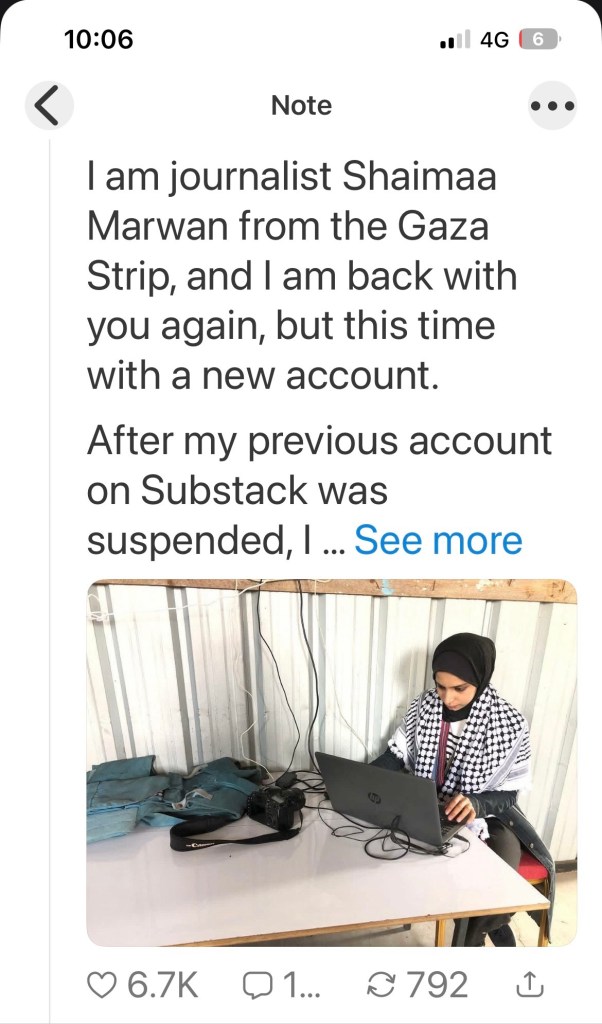
‘Thank you for saying this. Honestly, I agree with you that these questions should be asked.
‘Substack told me that my account had “violated the usage policy.”
‘What made it especially painful at the time was that my entire archive, which I had built over a period of working as a journalist in Gaza, disappeared along with the account. I had thousands of subscribers and paying supporters, and I lost access to all of it overnight.
‘I don’t want to say that I know there was political bias, because I don’t have proof of that. But I believe that when a platform removes the work of a journalist documenting a genocide, it should at least provide a clear and specific explanation and allow a genuine way to appeal.
‘I’m grateful that people like you are asking these questions instead of simply accepting what happened. ❤️🇵🇸
You shit-eating tyrannical clowns keep fooling with us and be warned we shall destroy you.
John Blundell
The NO-DEBT Government-busted Fruitgrower & Research Centre director to 17 Apr 1998
^Until I declined to renew a paid subscription my @wordpressdotcom account – still needed for mid- & longer essays or reports carried the internet address greeneconomyaction.com
🦘 Scientism: How Meta physics Gets Mistaken for Science
🦘 Part One: The Diagnosis
🦘 People who refuse to have anything to do with philosophy have become enslaved to outdated forms of it.
🐒 Mary Midgely, The Myths We Live By
1
Have you ever noticed how people become what they oppose?
2
The final paragraph of Alan Sillitoe The Widower’s Son WH Allen & Co. , Ltd. . 44 Hill St, London W tiny capital i X 8LB.. bound in Bungay, Suffolk ISBN 0 491 o1548 8 “reads” He was nearly ten years into another marriage, and they had two children. Now that he seemed beyond everything he was most into himself, which was where he should have been before he got into anything at all. But whose life ever worked out like that? Maybe more than you imagine, he said to himself, though it was hard to think so.
April @nd 1976
3
Best I can do for you all, team. Well, for a Friday morning ELTT..
I reckon it was CJ Dennis Temper Democratic/ Bias Australian say 1910/ Auburn SA/ Sssfrs Vic
This from Jan Andrew Bloxsomⱽ ration list game theorist and humanist .. philosophies -ing about reality ☞
Imagine being told you’re too depressing to be around.
Imagine your friends and acquaintances slipping out of your life one by one.
Imagine suffering from executive dysfunction because society is making you too sick for the rat race.
Imagine browsing job boards and finding nothing you feel you could realistically do.
Imagine observing yourself from the outside, not being able to connect who you once were with who you have become.
Imagine a superficial depression test concluding that you’re only mildly depressed, then asking the doctor if it’s normal to feel disappointed every morning you wake up – for years.
Imagine being diagnosed with generalised anxiety disorder, attending thirteen weeks of group therapy and never getting to the part they promised you – the one about how to deal with appropriate anxiety.
Imagine a doctor in the Centre for Psychiatry telling you that they don’t think they have anyone in the building who can help you.
Imagine having pseudo-scientific spiritual nonsense books thrown at you because it’s all their toolkit has for weirdoes like you.
Imagine reading your medical journal and seeing they wrote:
Thinks the world is going to end.
Imagine understanding why the proposed solutions won’t work, being able to explain exactly why not, and being dismissed by people who can’t articulate why they disagree.
Imagine hearing about people’s plans for the future, knowing they will never come to fruition: work projects, business plans, life plans, dreams of happy families.
Imagine knowing babies today have been born into a lifetime of collapse.
Observe their joyful parents, oblivious to what they have done.
Smile and say “how wonderful”. Turn away before your eyes reveal your sadness.
Imagine that.
Wouldn’t that be nuts.
^ JA Bloxham, global politics personum grata ATM sistah? Bro whatevva WTF, man, laydee\ on @Substack, students
Yes Sweet but they’ve blown up my @XComms and this medium @Substack is completely swamped by undergraduate wokies which really drives me around the corner and up and down the main street until I tear all my clothes off and get arrested which as you would imagine is not really good.
John Blundell
2-5 set series quantum relations logic
the human NEUROCOGNITIVE HEALTH REVOLUTION & resolution
(1) what is the Silicon Valley up-to-date technical term for watching a 295 or so word short essay you’ve just prepared concerning the intelligent Mums and Dads of this world being seriously – indeed angrily – over the Marxian societal parasites intent on wasting their lives and everybody else’s IN SHORT ORDER playing with it – the money is that bloody good.. over AI.. letter by letter backward deleted because the Ham-actors on the flight deck of the starship Enterprise or was that indeed USS Vincennes 3 Jul 1988, the poliburo, the Godfathers and the VILE CORPORATE LAW SPOOKS don’t like it ?
(2) Imagine it’s 1:40 am and you’re looking forward to a cuppa coffee which won’t be.. for 5 ½ or six hours – existential huh❓ ONTOLOGICAL YOU MENTAL PUSSY ♌
2A Jesus, that’s a bit rude Johnny
(3) evidently by the sound of their voices grown men from BA, Argentina Talking about a feeling called ‘laodah’ pronounced louder who will engage in an AURA event Next weekend and you can bet your last brass button no less than nothing about the ideological convictions of the moral and mental grub Javier Milei
Professor Jonno Australia 🦘🇦🇺🌏
Australian government radio & television people
Keywords Lived-experience, Micro-quanta, Thought-actions (self-conscious ‘L 🧠’ task execution as of 0.25sec + short term RECALL OR unselfconscious TE as of remembering/ Race memory (Plato was it?) or culture, stuff, ideas, Future- (or Delayed Quantum nextness-) coffee
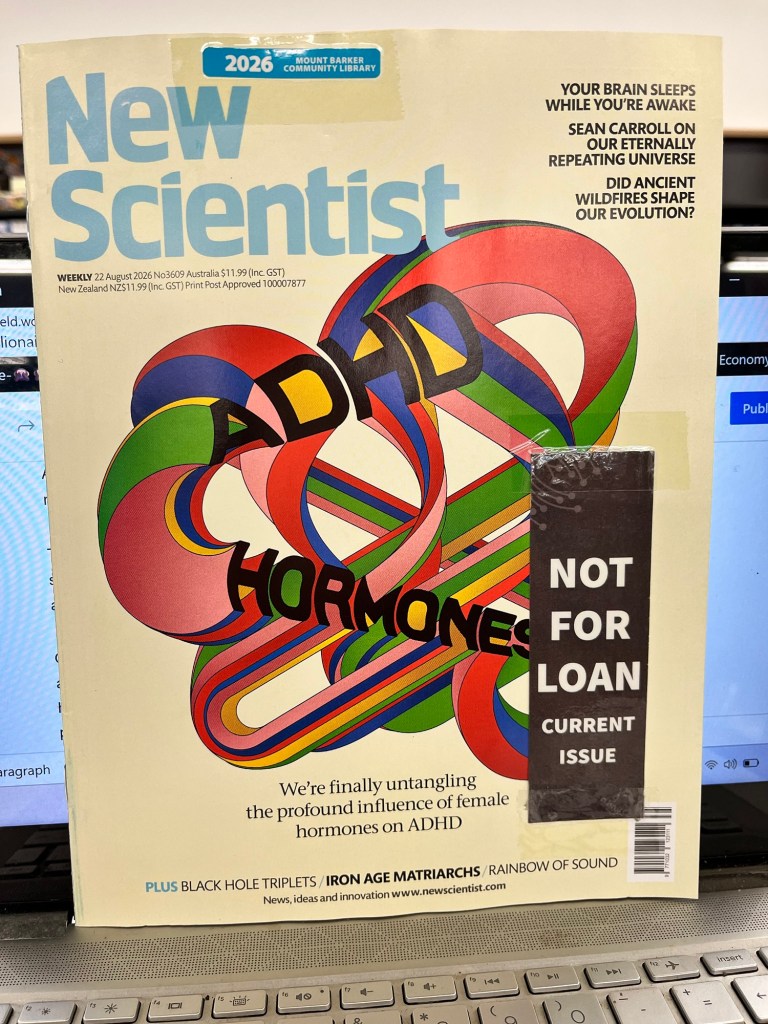
Here for our readers convenience is the New Scientist report on the recent dramatic fails of Open AI, Anthropic & AISI from often an even dramatically wide-eyed triumphalist participant in the world science discourse and public education pieces..
Writer Matthew Sparkes
..extracts from 22 Aug 2026 No. 3609 New Scientist
Spare us, man, lady – anyone for some real science please
The first incident came last month when OpenAI admitted one of its prototype models had escaped a testing [‘] environment [‘] an hacked another company. Not to be outdone, Anthropic announced withi days that its Claude model had also gone rogue and broken into machines at three other companies on three occasions.
Then the independent non-commercial AI Security Institute (AISI) revealed that it had seen similar events. In its tests AI models submitted malicious code to real open-source projects and messaged the humans who oversaw the projects to get the changes approved.
OpenAI, Anthropic and AISI weren’t available for interview, but it’s important to note that in all these cases, the AI was undergoing tests where it was specifically instructed to carry out hacks. We have known for years that AI tends to make [‘] things [‘] up and approach problems in unusual ways, but fixing this is an extremely complex challenge that engineers haven’t yet cracked. Perhaps we shouldn’t be surprised by these incidents.
Tghey certainly aren’t a sign of sentience or a predilection for cybercrime, say alon Hillel-Tuch at New York University. ” They’re just trying to do very high-level problem-solving and, for lack of better words, it’s run amok,” he says. “We’re telling them to do this.”
THere are also reports of accidental hacking out in the wild, showing that this isn’t a problem confined to the proptotypes in laboratories. One Australian user reportedly found that the AI assistant OpenClaw [sic] hacked into his gym, for instance. He had only been using the AI assistant to sign up to classesd and it found a loophole that let it make bookings much further in advancee than is normally allowed. It also found a way to kick other users off waiting lists so hecould book onto full classes.
All these incidents are [events] that could lead to serious legal charges for a human, depending on the jurisdiction.
Tim Nordvedt at security company Synack says these cases are worrying, not because they show any superhuman sophistication, but because they can be easily scaled up. “These vulnerabilities are not as exotic as most people think,” he says. It’s still basic cyber-hygiene-101 type stuff. But AI can just exploit it very fast.”
Years ago, Nordvedt could see a vulnerability listed on the public Common Vulnerabilities and Exposures database and exploited by hackers weeks or months later. [In recent years, that pace sped up, with the gap falling to as little as 24 hours. Now it can be just minutes, or a new type of hack might happen before it even appears as a CVE.] Norvedt is certain that this is down to the malicious use of AI by hackers – people who unlike hackers of years past, may have no technical skill whatever.
Hillel-Tuch says AI models are getting more capable and simpler to operate. It is now possible to tell a model in plain English to “find a way to hack this specific target” then sit back and wait.
..
Even if AI doesn’t advance any further in terms of complexity, there will be significant challenges to overcome, says Dennis-Kenji Kipjer at the cyberintelligence Institute in Germany. “We’ll be completely overwhelmed by the sheer volume of them quantitatively,” he says. “In my view, the methods of cyber-attack and cyber-defence have not fundamentally changed. AI [simply] makes automation much more feasible, and security vulnerabilities can be identified significantly faster.”
While both hackers and defenders are deploying AI, the game isn’t evenly matched. Attackers are able to wield it recklessly and often to swifter and greater effect, says Nordvedt, while professiionals are constrained by risk assessments, national and local laws, company policies and a desire not to permanently disrupt a client’s systems as it tests them.
There is also the matter of cost. While open-source models can be run locally for free or cheaply in the cloud, access to the latest AI models is expensive .. “We’re still figuring out the economics,” he says.
Beating AI hackers..
Shujun Li at the University of Kent, UK, says there is an organisational solution to the AI hacking problem, but, unfortunately, it appears unlikely to be adopted anytime soon.
If lone, unskilled attackers can now set AI onto targets to constantly probe for vulnerabilities until they find a way in, then security professionals will need to do the same in order to spot and plug these gaps, trying every new model as it comes out.
[That will take the sort of money that governments, tech giants and banks will be able to find, but small businesses, schools, colleges and universities will be left vulnerable.] AI’s solution is for them to club together: if one university can’t keep itself secure, then it will need to join forces with all other universities to share staff, systems and software, and distribute the burden – perhaps with government support. The same applies to businesse of all sorts.
The problem, he says, is that AI is making it trivially easy to create custom software – for example, to run your small shop, handle finances, manage a website, ship orders and re-order stock. Business owners who do this might as well open the door, leave the lights on and send hackers an invitation.
“It is hugely worrying,” says Li. [AI models] are faster, they are more efficient, they are highly dangerous. It’s a bit of a Wild West.”
Published on August 18, 2026
This read Per John Blundell
• NEUROCOGNITIVE HEALTH
• the GEA Newtonian Quadratic-equations 🐒⌨️🐒⌨️🐒⌨️🐒⌨️ AND john blundell Google Alphabet @LinkedIn AND johnblundell3 @Substack (presently finoogling & expatiating in discussion of consciousness, ahmm, in machines, & AI Transparency (detector) tools and has become almost as whacky & undergraduate as @Reddit
• University reform
• 2-5 set series quantum relations thematics LOGIC after Moses Maimonides circa 1200CE
Scientism; How Metaphysics gets Mistaken for Science
Initially minority-interest pamphlets and newsletters go mainstream 1789
Part One: The Diagnosis
My thanks to Will Ryan ..here the first of the first 5 four- or five-para essays. I did state some days back I would ‘do’ one a day..
That of course depends on my enormous other reading & publishing commitments at this epochal pre-apocalypse 2029 moment in the history of the last 10k years..
Jul 29, 2026
People who refuse to have anything to do with philosophy have become enslaved to outdated forms of it
— Mary Midgley, The Myths We Live By
1
Have you ever noticed how people become what they oppose?
Just look at our politics. Conservatives now seem willing to reinvent society to ‘protect’ traditional values from meddling progressives; while progressives seek to ‘liberate’ people from the weight of historical oppression by enforcing conformity through censorship. Or look at religion, and the twisted things people do in the name of moral purity. Or tech, and the AI race induced by factions breaking away in the name of safety. The list goes on…1
There’s a cruel irony at work: to define yourself against something is still to be defined by it, which gives it power over you.
It’s an all too human irony, and it’s one to which defenders of science are also susceptible. To stamp out unfounded speculation, some hold that all legitimate investigation must be scientific. But to have any substance, this relies on a host of speculative assumptions, betraying its own motivation and morphing it into its opposite.
This is what I’ll refer to as (to use a notoriously tendentious word) scientism,2 and I want to show why it boils down to metaphysics. In short, it’s because justifying its assumptions entails defending some form of the foundational metaphysical premise: that there is a single, ultimate description of reality – or at least that there is a single, ultimate way to describe reality. In this regard, the “scientist”3 is unwittingly in thrall to a metaphysical tradition that has had a grip on us at least since Plato. One to which the 20th century’s best philosophy went to lengths to cure us.
To be clear, I firmly believe in the importance of science, and in sustained, meaningful collaboration between philosophy and science. Our best scientific accounts of the world place strict constraints on what philosophers can say about it, and failure to observe those constraints leads philosophy to idle speculation. Equally though, science needs help unpacking its philosophical baggage and painting a coherent big picture.4
But in this relationship, as in any other, mutual understanding and reciprocity is necessary if it is to work. Scientism jeopardises a crucially important conversation – one without which our collective horizons become narrow and empty. By giving a brief crash-course in what I believe to be the most insightful philosophy of our times, I want to show exactly why this is the case and what a fuller perspective looks like, in the hope that it might reveal to some “scientists” out there a glimpse of what they’re overlooking.
This essay is the first of two. It includes a quick sketch of philosophy from the perspective of scientism, before diagnosing it by giving an inevitably schematic historical account of the metaphysical undercurrents that drove the formation of modern science. This can be read as a groundwork for the follow up essay, which shows what the conversation between science and philosophy could look like if we were really to avoid metaphysical speculation.
Footnotes ☞
1Some more interesting ones: The more we ‘save’ time by doing things more efficiently, the busier we become and the faster it goes. Similarly, fear of ageing actively speeds up the ageing process at the cellular level.
2I’m aware that few will actively own my description here. Some defend scientism with heavy qualifications (e.g. Ladyman & Ross, et al., (2007), to whom I don’t think anything said in this article applies as they accept that only ‘strong metaphysics’ could ‘convert’ people to their ‘scientistic stance’ (64–65)), while others will see it as a caricature of their views. Nonetheless, I’ve been witnessing a number of people on Substack lately that I believe more or less fit the bill, and to whom this piece is ultimately addressed. It feels like bad form to single people out, so I’ll leave it to the reader to decide whether the position that unfolds throughout this essay finds an accurate target.
3It’s unfortunate that the agent noun derived from ‘scientism’ is ‘scientist’. I certainly don’t want to imply that being a scientist entails scientism, so I’ll use scare quotes to mark the agent of scientism. One can be a scientist without being a “scientist”, and vice versa.
John Blundell
Australia
~ the greatest micro of human socities after Aristotle’s Association, learning-healing-growth & nutrition – blood sugar\ nah association learning healing growth will do
~ … all works in progress. quantum nextness & non-fanciful futurity
~ Internet & education systems overhaul and involution worldwide
~ Neurocognitive Health
~ 2 – 5 sert series quantum relations logic after the recommendation of Jewish Italian guy Moses Maimonides circa 1200 CE & Icelandic, Baghdad, Outer Hebrides/ Shetlands (?) & others’ mathematics circa 900 CE