
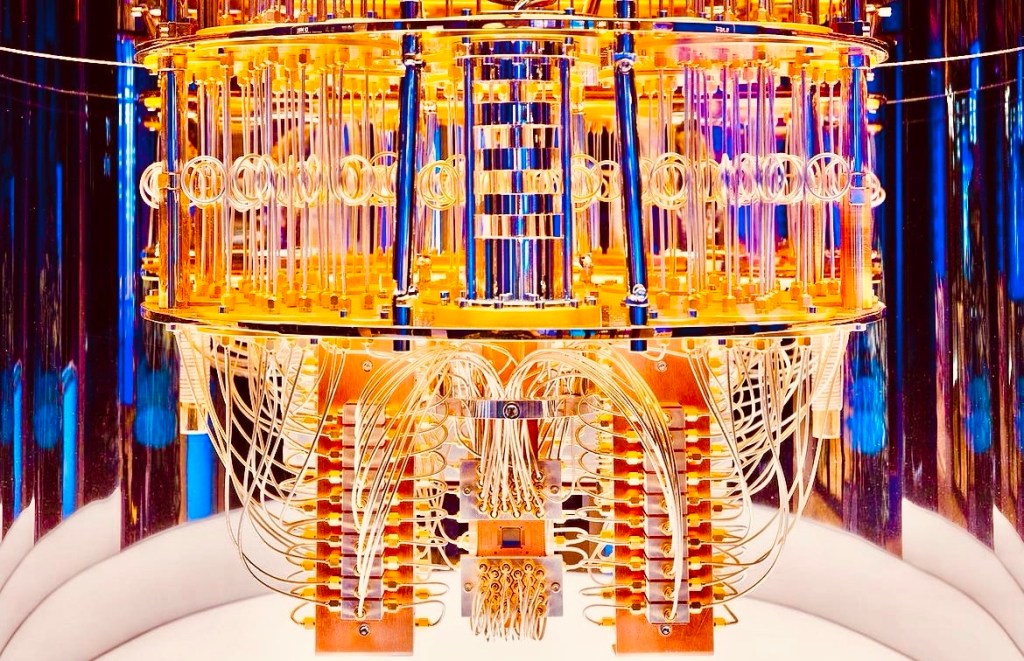
Credit: IBM Research
Quantum computing is one of the most exciting new technologies on the radar and it’s a field worth following closely. In the past months, weird things have been happening. And when I say weird, I don’t mean quantum weird, where a particle goes through two slits at once. I mean business weird, where a company goes through two roadmaps at once. Let’s have a look.
But first, what is a quantum computer? Quantum computers perform mathematical operations with logical units that have quantum properties, the so-called quantum bits or qubits for short. People sometimes say that this gives quantum computers special power because the number of qubits grows exponentially.
If you have a qubit with two states 1 and 0, then you can combine it with a second qubit to a product state. Then you have 00 01 10 and 11, that makes 4. Take a third and you have 8. For n qubits you have 2 to the n. It indeed grows exponentially!
Yes, but. Actually that’s the case already for standard bits! The quantum advantage does not just come from combining the qubits but from the possibility to entangle them. This means not only do you have 00 01 10 and 11. You can also take sums of those with arbitrary prefactors. Say 01 + 10, with weights that you can tune.
Now you see, these states don’t exist in a standard computer, so you have many more states you can calculate with. And this is why quantum computers can perform certain calculations much faster.
Alas, this advantage only becomes relevant for a large enough number of qubits, somewhere in the range of 100,000 to a million. A useful diagnostic is IBM’s roadmap to quantum computing. If you look at their roadmap from a few years ago, they were planning that by 2025 they would have more than 4,000 qubits and by 2026 they’d be scaling to 10,000 and up. If you look at their current roadmap, these qubit numbers have just disappeared. Clearly something didn’t quite go according to plan.
Instead, IBM, and others, have been quietly shifting goals. First they claimed that “noisy” quantum computers could have practical uses already. Unfortunately, these uses were nowhere to be found. Now they use “hybrid” approaches that combine both conventional and quantum computers. The advantage of those is that you can’t tell what the quantum part was good for.
IBM has for example recently announced they used quantum-centric supercomputing to simulate a big protein complex. Quantum-centric is newspeak for hybrid approaches. In this case most of the calculation was actually done by a classical supercomputer and they say in the paper themselves that the results of the purely conventional and partly quantum computation are comparable.
To be clear, this is all very interesting work but it is still far off any practical use. When it comes to practical uses all we have are increasingly bizarre claims like that “AI and quantum computing could deliver on the promise of personalized medicine” or that “quantum computers could boost AI”. When in doubt, sprinkle AI on it, it’s like the parsley of business.
That doesn’t deter the governments of the world from pouring money into it. I already reported recently that China has made quantum computing part of their new 5-year plan. Now, rather predictably, the US government has ramped up their investments into quantum computing as well. Just last week, they poured 2 billion dollars into quantum computing which, remember, is a technology that so far has zero practical use.
GlobalFoundries promptly launched Quantum Technology Solutions, a new quantum business for the quantum industry and its “pipeline of quantum innovators”. IBM says they’re building “a quantum foundry for quantum wafers to power America’s quantum leadership, quantum innovation and quantum ecosystem”. Wow, so much quantum, who would not be impressed.
What the heck is a quantum wafer you ask? Yes, good question. IBM and Google and Amazon use superconducting circuits as qubits. One of their main benefits is that you can print them using standard chip production methods on the standard silicon wafers.
They are not standard microchips, you need to print the wires with materials that become superconducting at low temperatures, but the production of the chips has never been the main problem. The problem is to find a use for them.
The one application for a large enough quantum computer that no one really doubts is that they could break some old encryption protocols. But this is not exactly a use case for the average person. And once the old protocols have been decrypted, that’s that.
The other use cases that you often hear, quantum chemistry, material science, logistics and finance, have all eroded one after the other. Either because AI is doing things that quantum computing was supposed to solve, or because no one could actually honestly find something useful to do with them, even theoretically.
To me all these billions being thrown at quantum computing look batshit crazy given the low expected return on investment. This is particularly obvious if you compare it to nuclear fusion which has a fraction of the funding, but dramatically clearer return on investment. Yes, I am now defending nuclear fusion as the practical option. That is how weird this has become.

